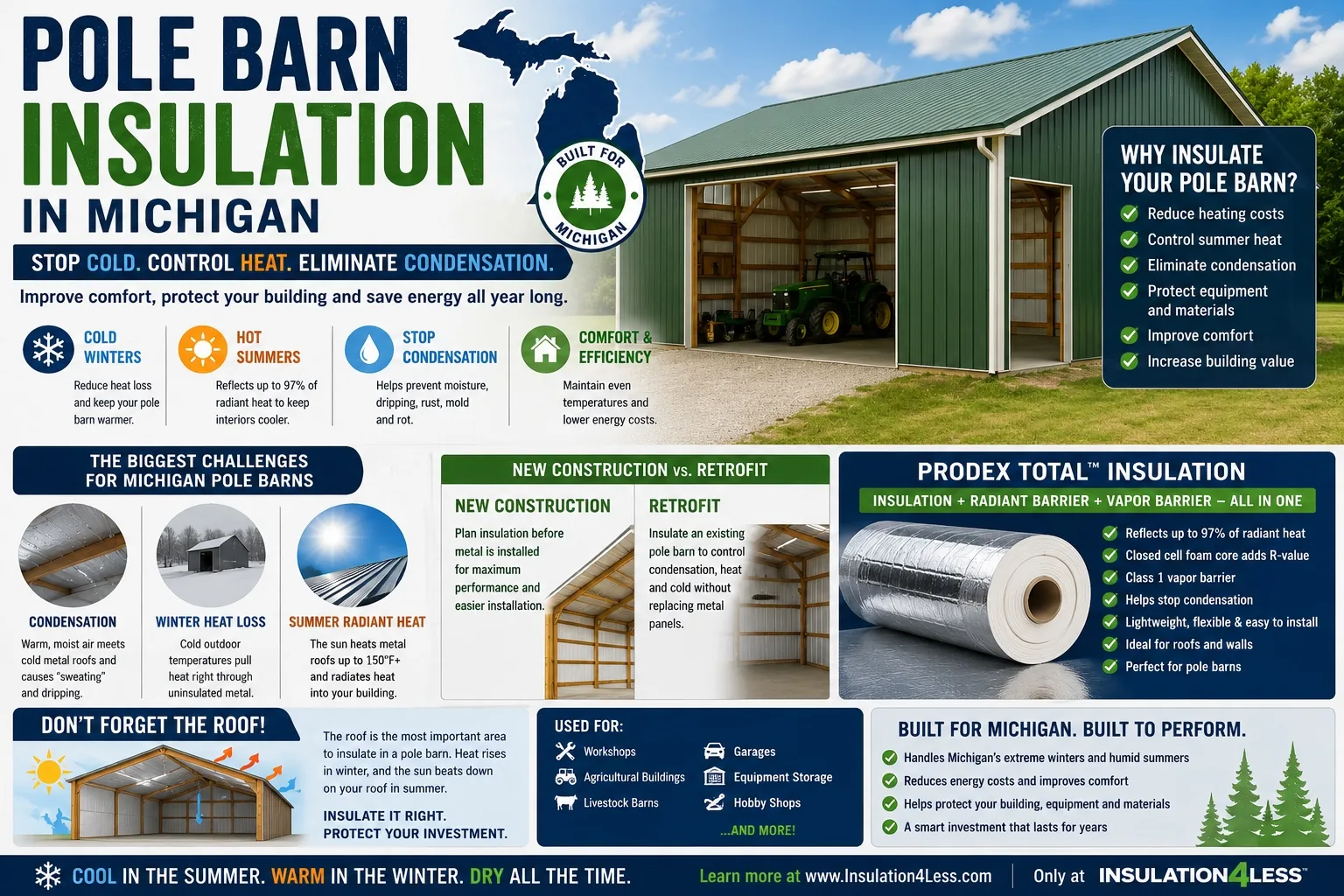
Pole Barn Insulation in Michigan: Stop Cold, Heat & Condensation
Michigan pole barns have to perform through freezing winters, warm summers and significant seasonal changes in temperature and humidity.
That creates several insulation challenges.
During winter, an uninsulated pole barn can rapidly lose heat through its metal roof and walls. During summer, sunlight striking the metal roof can create substantial radiant heat inside the building.
And throughout the year, changing temperature and humidity conditions can create one of the biggest problems in post-frame construction:
Condensation.
Whether your Michigan pole barn is used for agriculture, equipment storage, vehicles, livestock or as a heated workshop, the insulation system should address cold, radiant heat, moisture and air movement together.
For a comprehensive overview, see our national Pole Barn Insulation Guide.
Why Insulate a Pole Barn in Michigan?
Not every pole barn is used the same way.
Some are simple unheated equipment-storage buildings. Others function as:
- Heated workshops
- Garages
- Agricultural buildings
- Livestock barns
- Machinery storage
- Hobby shops
- Commercial buildings
- Vehicle storage
- Woodworking shops
How the building is used has a major effect on the insulation strategy. A heated workshop requires much greater attention to winter heat loss than an unheated equipment building. A livestock barn can generate substantial interior moisture. A garage that is heated only occasionally presents another set of conditions. The insulation should therefore be selected according to the actual use of the pole barn, rather than simply installing the same system in every post-frame structure.
Michigan Winters and Pole Barn Heat Loss
Michigan's cold winters can create a substantial temperature difference between the interior and exterior of a heated pole barn. Heat naturally moves from warmer areas toward colder areas.
Without insulation, heat can escape through:
- Metal roofing
- Metal siding
- Gaps around doors
- Wall and roof transitions
- Other penetrations in the building envelope
The larger the temperature difference, the more important the building envelope becomes. Insulation helps slow this heat transfer and can make heated pole barns more comfortable and economical to maintain.
Summer Radiant Heat in Michigan Pole Barns
Winter isn't the only concern. During sunny summer weather, metal roofing absorbs solar energy and becomes hot. That heated roof can radiate energy toward the interior of the pole barn, making the building considerably less comfortable.
This can be especially noticeable in buildings used as:
- Workshops
- Garages
- Livestock facilities
- Equipment-maintenance buildings
- Commercial workspaces
Reflective insulation can help address radiant heat when properly incorporated into the building assembly. For a detailed explanation, see our Reflective Insulation in Michigan guide.
Condensation in Michigan Pole Barns
Condensation deserves special attention in any metal-sided post-frame building. Warm air can hold moisture. When that warm, moisture-containing air contacts sufficiently cold metal, the air near the surface cools. If the temperature reaches the dew point, water vapor condenses into liquid water. This is why an apparently watertight pole barn can sometimes seem to be "raining" inside. The roof isn't necessarily leaking. The moisture may be condensation.
Why Pole Barn Roofs Sweat
During a cold Michigan night, the metal roof can become extremely cold. Moisture generated inside the building—or introduced through outside air—can encounter the cold roofing surface and condense. Water droplets may then collect on the underside of the roof and eventually drip.
Potential consequences include:
- Wet equipment
- Rust and corrosion
- Damp stored materials
- Mold or mildew on susceptible surfaces
- Wet wood framing
- Damage to interior finishes
- Uncomfortable working conditions
Controlling condensation should therefore be part of the insulation strategy from the beginning.
The Roof Should Be a Priority
The roof is generally the most critical area to address in a Michigan pole barn. It receives direct solar radiation during summer and forms a major part of the thermal envelope during winter. It is also a common location for visible condensation. If budget or construction considerations require prioritizing different parts of the building, the roof deserves particular attention.
For additional information, see Roof & Ceiling Insulation in Michigan and our national Roof Insulation Guide.
New Construction Pole Barn Insulation
The easiest time to plan insulation is before the metal roofing and siding are installed. New construction makes it possible to coordinate the insulation system with the building structure and exterior panels.
Advantages can include:
- More continuous insulation coverage
- Fewer difficult penetrations
- Easier treatment of roof and wall transitions
- Better planning for air spaces
- Easier vapor-control planning
- Reduced installation complexity
Insulation should ideally be considered during the design of the pole barn rather than after construction is complete.
Insulating an Existing Michigan Pole Barn
Existing pole barns can also be insulated, but the installation approach changes because roofing, siding and structural components are already in place.
Retrofit installations may need to accommodate:
- Posts
- Girts
- Purlins
- Trusses
- Bracing
- Electrical wiring
- Doors and windows
- Existing wall or ceiling finishes
Before beginning a retrofit, determine whether condensation or water intrusion is already present. A moisture problem should be understood before it is concealed behind a new interior finish.
Reflective Insulation for Michigan Pole Barns
Reflective insulation can be particularly useful in metal-roofed pole barns because it addresses radiant heat in addition to conductive heat transfer when used in the proper assembly. Prodex Total uses reflective surfaces with a closed-cell foam core. Depending on the specific Prodex product and installation, it can combine multiple building-envelope functions.
Prodex Total = Insulation + Radiant Barrier + Vapor Barrier — All in One Product.
This combination can be useful in pole barns where insulation, radiant heat and moisture control must all be considered. For more information about how reflective insulation works, see our national Reflective Insulation Guide.
Fiberglass Insulation in Michigan Pole Barns
Fiberglass is commonly used in many types of buildings, including post-frame structures. However, pole-barn applications require attention to installation quality and moisture.
Important considerations include:
- Compression
- Gaps
- Air movement
- Moisture exposure
- Vapor control
- Maintaining designed thickness
Fiberglass should be evaluated as part of the entire wall or roof assembly rather than solely by its labeled R-value. For a side-by-side discussion, see Fiberglass Insulation vs. Prodex Total in Michigan.
Heated Pole Barns and Workshops
Insulation becomes particularly important when a Michigan pole barn is heated. Heating increases the temperature difference between the interior and cold exterior surfaces during winter. It can also increase condensation potential if moisture-containing interior air reaches cold metal surfaces.
A heated workshop may therefore benefit from attention to:
- Roof insulation
- Wall insulation
- Air sealing
- Vapor control
- Doors
- Windows
- Ventilation
- Interior moisture sources
If your pole barn primarily functions as a workshop or garage, see Metal Garage & Workshop Insulation in Michigan.
Agricultural Pole Barns
Agricultural buildings require special consideration because building use can affect interior moisture dramatically. A pole barn containing livestock can experience much higher moisture loads than an equipment-storage building.
Other factors may include:
- Animal respiration
- Wet floors
- Stored crops
- Washing
- Ventilation requirements
- Frequent opening of large doors
Insulation cannot substitute for proper ventilation where ventilation is required. The building's use, moisture production and ventilation strategy should all be considered when selecting the insulation system.
Metal Pole Barns vs. Other Steel Buildings
Pole barns are generally post-frame structures, while many commercial steel buildings use rigid steel frames. The framing differs, but both building types commonly use metal roofing and siding.
That means they can share several insulation challenges:
- Conductive heat transfer
- Radiant heat
- Condensation
- Air infiltration
- Thermal bridging
For information on larger steel structures, visit Metal Building Insulation in Michigan. Our national guide to insulation for steel buildings provides additional information about steel-building applications.
How Much Insulation Does a Michigan Pole Barn Need?
There isn't one answer for every building.
The amount and type of insulation depend on factors such as:
- Pole barn dimensions
- Roof configuration
- Wall height
- Whether the roof, walls or both will be insulated
- Heated or unheated use
- Desired interior temperature
- Moisture generation
- Local climate conditions
- Applicable energy and building codes
When calculating material requirements, use the actual surface area being insulated rather than simply using the building's floor square footage. Our How Much Insulation Do I Need? guide explains how to estimate insulation requirements more accurately.
Choosing Insulation for a Michigan Pole Barn
Before choosing an insulation system, ask:
Is the Pole Barn Heated?
A heated building generally requires greater attention to heat loss and condensation.
Is It Air-Conditioned?
Cooling changes the direction of heat and moisture movement during summer.
What Is Stored Inside?
Vehicles, machinery, livestock and moisture-sensitive materials can create very different requirements.
Is Condensation Already Present?
If the roof is already sweating, determine why before covering it.
Is It New Construction or a Retrofit?
The available installation methods differ considerably.
What Do Local Codes Require?
Building and energy-code requirements vary by location and building use. Verify applicable requirements with the appropriate Michigan building officials before selecting the final insulation assembly.
Pole Barn Insulation and Year-Round Michigan Performance
A Michigan pole barn has to deal with more than cold weather. Winter can produce heat loss, cold steel surfaces and condensation. Summer sunlight can turn an unprotected metal roof into a powerful source of radiant heat. An effective insulation strategy should consider the building through all four seasons.
The goal is simple:
Cool in the Summer. Warm in the Winter. Dry all the Time.
By considering insulation, radiant heat, air movement and moisture as parts of the same building-envelope system, Michigan pole barn owners can create buildings that are more comfortable, efficient and better protected throughout the year.
Explore Michigan Insulation Guides
Continue exploring insulation solutions for Michigan buildings:
- Michigan Insulation Guide
- Metal Building Insulation in Michigan
- House Insulation in Michigan
- Roof & Ceiling Insulation in Michigan
- Fiberglass Insulation vs. Prodex Total in Michigan
- Quonset Hut Insulation in Michigan
- Reflective Insulation in Michigan
- Metal Garage & Workshop Insulation in Michigan
- Shipping Container Insulation in Michigan