Reflective Insulation in Michigan: Radiant Heat, Cold & Condensation Control
Michigan is known for cold winters, but insulation decisions shouldn't be based on winter temperatures alone. Summer sunlight can heat roofs—especially metal roofs—to temperatures substantially above the surrounding outdoor air. That heated surface can then radiate energy toward the building interior. Reflective insulation is designed specifically to address this form of heat transfer. When incorporated into an appropriate building assembly, reflective insulation can help reduce radiant heat while other components of the system address conductive heat, air movement, vapor and condensation.
This makes reflective insulation particularly relevant to Michigan:
- Metal buildings
- Pole barns
- Garages
- Workshops
- Agricultural buildings
- Quonset huts
- Shipping containers
- Selected residential applications
For a comprehensive explanation of the technology, see our national Reflective Insulation Guide.
What Is Reflective Insulation?
Reflective insulation uses low-emissivity reflective surfaces to reduce radiant heat transfer. This is different from conventional mass insulation such as fiberglass. Fiberglass primarily slows conductive heat transfer by trapping air within its fibers. Reflective insulation addresses radiant energy.
The distinction matters because heat moves through buildings in several ways:
- Conduction
- Convection and air movement
- Radiation
A building-envelope system should consider the heat-transfer mechanisms that are actually affecting the building.
How Radiant Heat Works
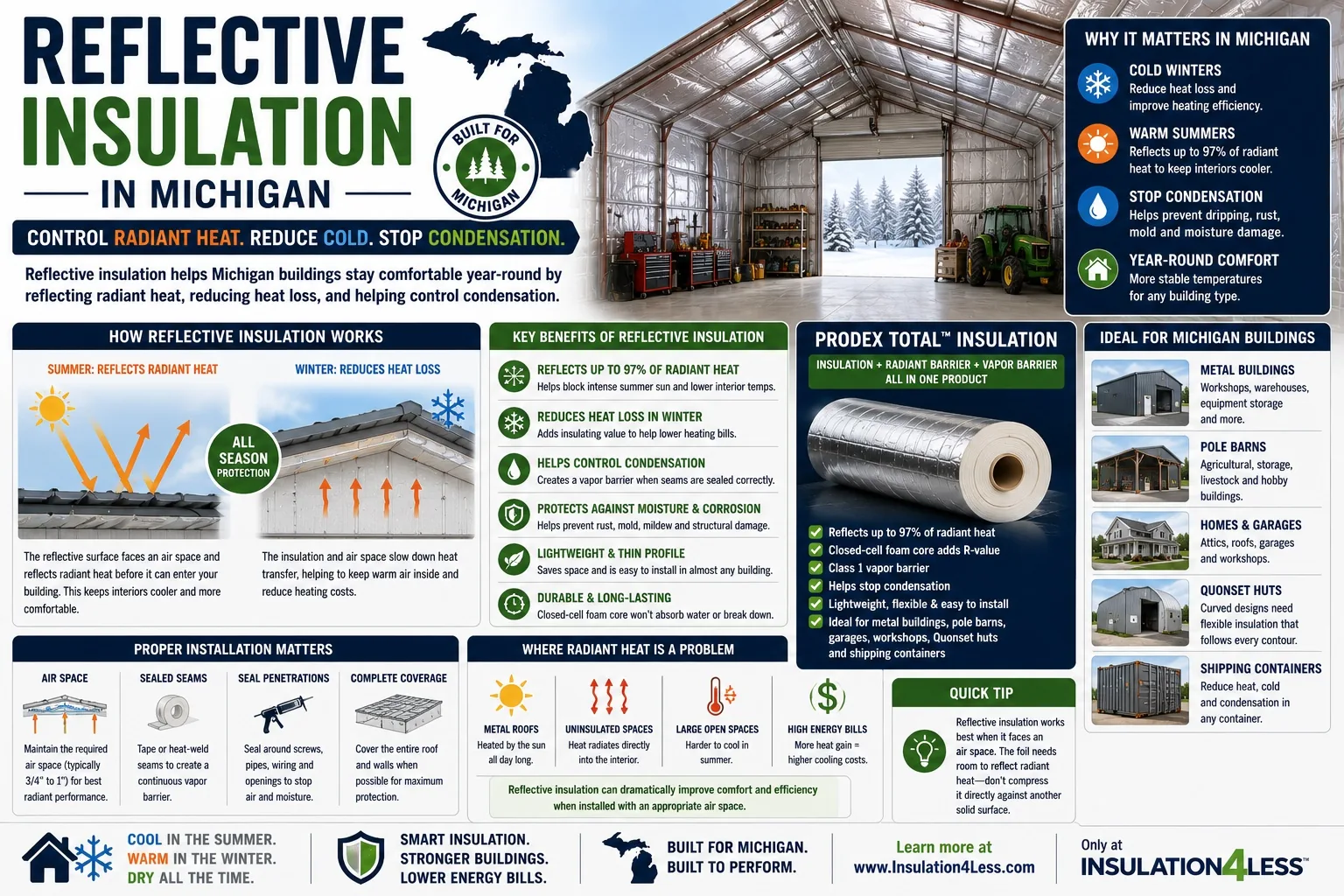
Radiant heat travels through space as electromagnetic energy. You experience radiant heat when standing near a hot surface even though you are not touching it. The same principle applies inside buildings. During summer, sunlight heats a roof. The hot roofing material can then radiate energy toward cooler surfaces below it. Metal roofs can make this effect particularly noticeable because steel absorbs solar energy and conducts heat readily. A reflective surface facing an appropriate air space can reduce the amount of radiant energy transferred across that space.
Why Reflective Insulation Needs an Air Space
This is one of the most important principles to understand about reflective insulation:
A reflective surface needs to face an air space to function effectively as a radiant barrier.
If a reflective surface is tightly sandwiched between solid materials with no air space, the heat-transfer mechanism becomes primarily conductive rather than radiant. That reduces the benefit provided by the reflective surface. Correct installation is therefore essential. The required air space depends on the particular product and tested assembly. Always follow the installation instructions for the specific insulation system being used.
Reflective Insulation vs. Radiant Barrier
The terms reflective insulation and radiant barrier are related but are not always interchangeable. A radiant barrier is primarily intended to reduce radiant heat transfer. Reflective insulation can incorporate reflective surfaces while also providing additional thermal resistance through other materials within the product. Prodex Total, for example, combines reflective surfaces with a closed-cell foam core. This allows the product to address both radiant and conductive heat as part of an appropriate assembly.
Reflective Insulation for Michigan Metal Buildings
Metal buildings are among the strongest applications for reflective insulation. Large steel roofs can absorb significant solar energy during summer. During Michigan winters, the same steel surfaces become cold and can contribute to heat loss and condensation.
An insulation system for a steel building should therefore consider:
- Conductive heat
- Radiant heat
- Air movement
- Water vapor
- Condensation
Reflective insulation can address radiant heat while properly designed products and assemblies can contribute to the other building-envelope functions. See Metal Building Insulation in Michigan for a complete discussion. Our national guide to metal building insulation explains how these factors interact in steel structures.
Reflective Insulation for Michigan Pole Barns
Pole barns commonly use large metal roof and wall surfaces. That creates many of the same radiant-heat and condensation issues found in conventional steel buildings. During summer, the roof can become a major source of radiant heat. During winter, the metal can become cold enough for interior moisture to condense. Reflective insulation can be especially useful when incorporated into the building during construction, but existing pole barns can also be retrofitted.
See Pole Barn Insulation in Michigan.
Reflective Insulation Under Metal Roofs
The roof is generally the first place to evaluate radiant heat. It receives direct solar exposure for much of the day. A reflective insulation system beneath a metal roof can help reduce radiant energy moving toward the building interior when the reflective surface faces the appropriate air space.
This can improve summer comfort in:
- Metal buildings
- Pole barns
- Garages
- Workshops
- Agricultural structures
Roof assemblies must also be designed for winter conditions and moisture. See Roof & Ceiling Insulation in Michigan and our national Roof Insulation Guide.
Does Reflective Insulation Work During Winter?
Reflective insulation isn't only a summer product. Radiant heat transfer can occur whenever surfaces are at different temperatures. However, Michigan winter performance should be evaluated as part of the complete insulation assembly. Conductive thermal resistance becomes particularly important during cold weather. Products such as Prodex Total combine reflective surfaces with a foam core so the system isn't relying solely on reflectivity. The final assembly should be selected according to the thermal performance required for the building.
Prodex Total Reflective Insulation
Prodex Total combines reflective surfaces with a closed-cell polyethylene foam core. Depending on the specific Prodex product and installation assembly, it can provide multiple building-envelope functions.
Prodex Total = Insulation + Radiant Barrier + Vapor Barrier — All in One Product.
Prodex Total can be particularly useful where builders want to address:
- Conductive heat
- Radiant heat
- Water vapor
- Condensation
- Limited installation space
Its thin, flexible construction can also simplify installation in many metal structures.
Reflects Up to 97% of Radiant Heat
Prodex Total's reflective surfaces can reflect up to 97% of radiant heat when used in the appropriate assembly. This does not mean that the product eliminates 97% of all heat transfer through a building. Conductive heat, air leakage and other mechanisms still matter. Instead, the figure relates specifically to radiant energy interacting with the reflective surface. Understanding this distinction is important when comparing reflective insulation with conventional insulation.
Reflective Insulation and Condensation
Reflective insulation can also play a role in assemblies designed to control condensation. Condensation occurs when moisture-containing air encounters a surface cold enough to reach the dew point. This is particularly common in metal buildings. A properly installed insulation and vapor-control system can help separate warm interior air from cold steel surfaces and limit moisture movement toward those surfaces. The objective is to prevent conditions that allow water to accumulate on or within the building assembly.
Reflective Insulation and Vapor Control
Some reflective insulation products can also function as vapor-control layers. Prodex Total's construction provides vapor-barrier characteristics when installed according to the applicable product instructions and when seams and penetrations are appropriately sealed. This can be valuable in metal buildings where vapor movement and condensation must be considered together. Continuity is important. Open seams, edges and penetrations can compromise the performance of an otherwise continuous vapor-control layer.
Reflective Insulation vs. Fiberglass
Reflective insulation and fiberglass operate differently. Fiberglass is primarily mass insulation designed to resist conductive heat transfer. Reflective insulation is designed to reduce radiant heat transfer while some reflective insulation products also provide conductive thermal resistance. The better choice depends on the building assembly. For example, conventional residential wall cavities can provide ample space for thick fiberglass insulation. A metal building with significant radiant heat and condensation concerns may benefit from a different approach.
See Fiberglass Insulation vs. Prodex Total in Michigan for a detailed comparison.
Reflective Insulation for Michigan Homes
Reflective insulation can also be used in selected residential applications.
Potential applications may include:
- Roof assemblies
- Attics
- Cathedral ceilings
- Garages
- Workshops
- Certain walls and floors
However, reflective insulation should not automatically replace conventional residential insulation. The correct system depends on the assembly, required thermal performance, air spaces, moisture conditions and applicable codes.
For broader residential guidance, see House Insulation in Michigan.
Reflective Insulation for Garages & Workshops
Michigan garages and workshops can experience large temperature swings. Metal garages in particular can become very cold during winter and hot under summer sunlight. Reflective insulation can help address summer radiant heat while the complete insulation system reduces winter heat transfer and helps control condensation. This can be especially useful when the building is used as a heated workshop.
See Metal Garage & Workshop Insulation in Michigan. You can also learn more about insulation for steel buildings.
Reflective Insulation for Quonset Huts
Quonset huts are particularly well suited to flexible reflective insulation. Their curved steel shells create a large surface exposed to solar radiation and winter cold. A flexible insulation product can follow the curved structure while conserving valuable interior space. Prodex Total can also provide radiant, thermal and vapor-control functions in one system.
See Quonset Hut Insulation in Michigan and our national Quonset Hut Insulation Guide.
Reflective Insulation for Shipping Containers
Shipping containers are another strong application. Their corrugated steel shells readily conduct exterior temperatures. During summer, direct sunlight can heat the roof and walls. During Michigan winters, the steel can become extremely cold. Interior space is also limited, making thick insulation systems less attractive in some conversions. Reflective insulation with a thin foam core can help conserve usable interior dimensions while addressing radiant heat and condensation.
See Shipping Container Insulation in Michigan.
New Construction vs. Retrofit
Reflective insulation can be used in both new and existing buildings.
New Construction
Installing insulation during construction can make it easier to:
- Maintain continuous coverage
- Create required air spaces
- Seal seams
- Coordinate vapor control
- Work around framing
- Minimize penetrations
Retrofit
Existing buildings can also be insulated from the interior.
Retrofit installation requires consideration of:
- Existing framing
- Purlins and girts
- Electrical systems
- Lighting
- Doors and windows
- Existing condensation
- Attachment methods
Any unexplained moisture problem should be investigated before it is covered.
Installation Quality Matters
Reflective insulation performance depends heavily on installation.
Important considerations include:
- Correct product orientation
- Required air space
- Continuous coverage
- Properly sealed seams
- Sealed penetrations
- Secure attachment
- Moisture conditions
- Appropriate building assembly
A high-performance insulation product installed incorrectly may perform substantially below expectations.
How Much Reflective Insulation Do You Need?
Material requirements depend on the actual surfaces being insulated.
For a metal building or pole barn, you may need to calculate:
- Roof area
- Wall area
- End walls
- Doors and other openings
Roof pitch matters because a sloped roof has more surface area than the building's flat floor dimensions suggest. For estimating assistance, see How Much Insulation Do I Need?.
Choosing Reflective Insulation in Michigan
Before selecting reflective insulation, consider:
What Type of Building Is It?
Metal buildings, houses and shipping containers require different assemblies.
Is Radiant Heat a Significant Problem?
Large sun-exposed metal roofs are particularly strong candidates for reflective insulation.
Is Condensation Occurring?
Determine why moisture is forming and design the assembly accordingly.
Is the Building Heated or Cooled?
Interior conditions affect heat and moisture movement.
Can You Maintain the Required Air Space?
This is critical to radiant-barrier performance.
What Thermal Performance Is Required?
Reflectivity is only one part of overall thermal performance.
What Do Local Codes Require?
Verify applicable thermal, fire and building-code requirements with the appropriate officials before selecting the final assembly.
Reflective Insulation for Michigan's Four Seasons
Michigan insulation has to perform through more than one extreme. Winter creates substantial temperature differences between heated interiors and cold outdoor surfaces. Summer introduces solar radiation and radiant heat. Changing humidity and temperatures can also create condensation. Reflective insulation provides a way to address radiant heat while products such as Prodex Total combine that function with additional thermal and vapor-control characteristics.
The objective remains:
Cool in the Summer. Warm in the Winter. Dry all the Time.
Rather than choosing insulation based on one specification, evaluate how the complete system manages conduction, radiation, air movement, vapor and moisture.
Explore Michigan Insulation Guides
Continue exploring insulation solutions for Michigan buildings:
- Michigan Insulation Guide
- Metal Building Insulation in Michigan
- Pole Barn Insulation in Michigan
- House Insulation in Michigan
- Roof & Ceiling Insulation in Michigan
- Fiberglass Insulation vs. Prodex Total in Michigan
- Quonset Hut Insulation in Michigan
- Metal Garage & Workshop Insulation in Michigan
- Shipping Container Insulation in Michigan