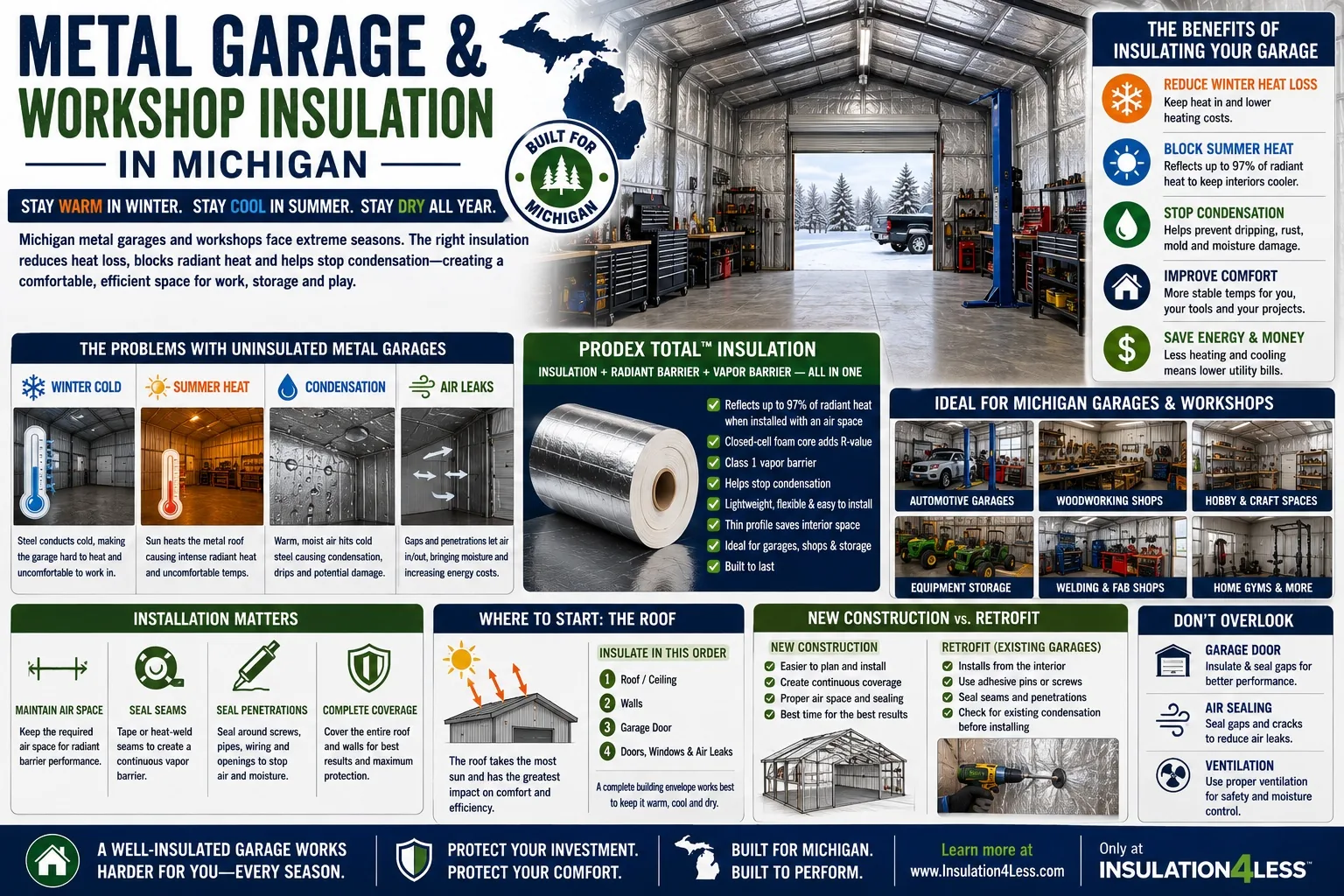
Metal Garage & Workshop Insulation in Michigan: Stay Warm, Cool & Dry
A metal garage can protect vehicles, tools and equipment from Michigan weather—but bare steel does little to protect the interior from temperature extremes.
During winter, metal roofing and siding become cold and readily transfer heat toward the outdoors. During summer, direct sunlight can turn a metal roof into a large source of radiant heat. And when warm, moisture-containing air encounters cold steel, condensation can develop on the inside of the building. These problems become especially noticeable when a garage is also used as a workshop.
If you're spending hours woodworking, repairing vehicles, welding, maintaining equipment or working on hobbies, insulation can transform a seasonal metal garage into a much more useful year-round workspace.
For additional information, see our national Metal Garage Insulation Guide.
Why Insulate a Michigan Metal Garage?
An uninsulated garage largely follows outdoor conditions. Insulation creates a thermal separation between the interior and exterior.
Depending on the building and insulation system, it can help:
- Reduce winter heat loss
- Reduce summer heat gain
- Control radiant heat
- Help prevent condensation
- Limit unwanted air movement
- Improve working comfort
- Reduce heating and cooling demand
- Protect tools and stored materials
The benefits become particularly important when the garage is heated or cooled.
Michigan Winters and Metal Garages
Michigan winters create challenging conditions for steel buildings. When outdoor temperatures fall, the roof and wall panels become cold. If you heat the garage, the temperature difference between the interior and exterior increases. Without insulation, heat readily transfers through the building envelope. This can make the garage difficult and expensive to keep comfortable. A properly insulated garage slows this transfer and allows heating equipment to maintain interior temperatures more effectively.
Summer Heat Can Be Just as Uncomfortable
Cold isn't the only problem. A metal garage exposed to direct summer sunlight can become extremely hot. The roof absorbs solar energy throughout the day. As the steel heats, it can radiate energy toward the floor, vehicles, tools and people below. This can make the interior considerably warmer and less comfortable even when outdoor temperatures are moderate. Reflective insulation can be especially valuable in metal buildings because it is designed to reduce radiant heat transfer when installed with the appropriate air space.
See Reflective Insulation in Michigan for more information.
Condensation Inside Michigan Metal Garages
Condensation is one of the most overlooked metal-garage problems. Warm air can contain water vapor. When that air contacts sufficiently cold steel, the air near the surface cools below its dew point and water can form.
You may see:
- Droplets on the roof
- Moisture on wall panels
- Water dripping onto vehicles
- Damp tools
- Wet floors
- Moisture around framing
Owners sometimes assume the roof is leaking when the actual problem is condensation.
Why Heated Workshops Can Have More Condensation Risk
Heating a garage makes it more comfortable, but it can also create a larger temperature difference between interior air and cold exterior steel. Activities inside the workshop may also introduce moisture.
Potential sources include:
- Wet or snow-covered vehicles
- Melting snow
- People
- Combustion appliances
- Washing
- Damp equipment
- Outdoor air entering through doors
If that moisture reaches cold metal surfaces, condensation can result. This is why insulation, vapor control, air control and ventilation should be considered together.
Protecting Tools, Vehicles and Equipment
Condensation isn't simply a comfort problem. Repeated moisture can affect items stored inside a garage or workshop.
Potential concerns include:
- Rust on tools
- Corrosion on machinery
- Damp cardboard boxes
- Moisture-sensitive materials
- Mold or mildew on susceptible surfaces
- Damage to wood products
- Moisture around electrical equipment
Keeping the interior drier can help protect both the building and what is stored inside it.
Start With the Roof
If you're deciding where to begin insulating a Michigan metal garage, the roof deserves particular attention. It faces the sun during summer and cold outdoor conditions during winter. It is also one of the most common locations for visible condensation.
A roof insulation system can help address:
- Winter heat loss
- Summer radiant heat
- Condensation
- Interior comfort
See Roof & Ceiling Insulation in Michigan and our national Roof Insulation Guide.
Don't Ignore the Walls
Once the roof is addressed, wall insulation can further improve building-envelope performance. A heated garage with an insulated roof but bare metal walls can still experience substantial heat transfer. Wall insulation can also help separate warm interior air from cold exterior steel. For the best performance, roof and wall systems should work together as a reasonably continuous insulation envelope.
Reflective Insulation for Michigan Metal Garages
Reflective insulation is particularly relevant to metal garages because of the large metal surfaces exposed to solar radiation. It addresses a heat-transfer mechanism that conventional mass insulation is not specifically designed to control: radiation. When a reflective surface faces an appropriate air space, it can reduce radiant energy crossing that space. This can be especially useful under metal roofing. Reflective insulation can therefore form part of a year-round system addressing both summer and winter performance.
Prodex Total for Garages & Workshops
Prodex Total combines reflective surfaces with a closed-cell polyethylene foam core.
Depending on the specific product and installation assembly, Prodex Total can provide several functions:
- Thermal insulation
- Radiant-barrier performance
- Vapor-barrier performance
- Condensation control
- Air-control characteristics when seams and penetrations are properly sealed
Prodex Total = Insulation + Radiant Barrier + Vapor Barrier — All in One Product.
This combination can be particularly useful in metal garages where interior space is valuable and condensation and radiant heat are important concerns.
Prodex Total for New Metal Garages
The easiest time to plan garage insulation is before the exterior metal panels are completely installed.
New construction allows the insulation system to be coordinated with:
- Purlins
- Girts
- Roof panels
- Wall panels
- Doors
- Windows
- Electrical systems
- Interior finishes
It can also make it easier to create continuous insulation coverage and maintain appropriate air spaces. Planning insulation before construction is generally preferable to deciding how to add it afterward.
Insulating an Existing Michigan Metal Garage
Existing garages can also be insulated. A retrofit system is typically installed from the interior because the exterior metal panels are already in place.
The installation may need to accommodate:
- Purlins
- Girts
- Structural framing
- Bracing
- Electrical wiring
- Lighting
- Garage-door tracks
- Windows
- Shelving
Before covering the steel, inspect the building for roof leaks, existing condensation and corrosion. Identify the cause of any moisture before concealing it.
Fiberglass in Metal Garages
Fiberglass can provide effective thermal resistance and is commonly used in many buildings. However, a metal garage requires careful consideration of the complete assembly.
Potential issues include:
- Compression
- Gaps
- Moisture
- Vapor control
- Air movement
- Contact with cold metal surfaces
Fiberglass itself is not an air barrier, and unfaced fiberglass does not provide an inherent vapor barrier. Additional components may therefore be required depending on the assembly. See Fiberglass Insulation vs. Prodex Total in Michigan for a detailed comparison.
Metal Garage vs. Pole Barn Workshop
Many Michigan workshops are built using post-frame construction rather than rigid steel framing.
These buildings may be called:
- Pole barns
- Pole buildings
- Post-frame garages
- Barn workshops
- Equipment shops
Although the framing differs, they often have similar metal roofing and siding. That means many of the same principles apply. If your garage is a post-frame building, see Pole Barn Insulation in Michigan.
Larger Steel Workshops
Commercial workshops and larger steel garages often use rigid steel frames. These structures can have large roof and wall areas, making heat transfer and condensation particularly important. Our Metal Building Insulation in Michigan guide covers these larger applications. For additional information about insulation for steel buildings, see our national metal-building guide.
Automotive Garage Insulation
Automotive garages have some special considerations. Vehicles can introduce significant moisture during Michigan winters. A car or truck entering with snow, slush and ice can bring water directly into the building. As that snow melts, interior humidity can increase. This can contribute to condensation if moisture reaches cold metal surfaces. Automotive garages may therefore require both insulation and adequate ventilation.
Woodworking Shop Insulation
Woodworking shops benefit from relatively stable interior conditions. Insulation can help improve comfort while also moderating temperature swings. However, woodworking introduces other considerations. Dust collection, ventilation and fire safety should be designed separately from the insulation system. Insulation should never interfere with required ventilation or safe clearances around equipment.
Hobby Shop Insulation
A garage used primarily for hobbies may not need to maintain residential temperatures around the clock. But insulation can still make intermittent heating and cooling considerably more effective.
Applications may include:
- Restoration projects
- Crafts
- Motorcycle work
- Model building
- Home projects
- Equipment repair
- Recreational spaces
The appropriate insulation level depends on how frequently the space is occupied and the desired interior conditions.
Garage Door Insulation
Large overhead doors can represent a substantial portion of a garage wall. Insulating the roof and walls while leaving a poorly performing garage door can create a weak area in the thermal envelope.
Consider:
- Door insulation
- Weatherstripping
- Perimeter seals
- Bottom seals
- Gaps around tracks and framing
Frequently opening a large overhead door will obviously exchange significant indoor and outdoor air regardless of insulation.
Windows and Personnel Doors
Windows and entry doors can also affect performance.
Inspect for:
- Failed weatherstripping
- Gaps
- Poor seals
- Damaged thresholds
- Air leakage
The best insulation system cannot compensate completely for large uncontrolled openings elsewhere in the building envelope.
Air Sealing a Metal Workshop
Air leakage can increase heating and cooling requirements and transport moisture through the building.
Potential leakage points include:
- Roof-to-wall transitions
- Doors
- Windows
- Electrical penetrations
- Plumbing penetrations
- Exhaust systems
- Wall-to-floor transitions
Insulation and air sealing should therefore be coordinated rather than treated as unrelated projects.
Ventilation Still Matters
Insulation should not be used as a substitute for ventilation.
Workshops may produce:
- Moisture
- Welding fumes
- Exhaust gases
- Paint fumes
- Wood dust
- Chemical vapors
Appropriate ventilation may be required for occupant safety and moisture control. The building's mechanical systems should be designed according to its actual use.
How Much Insulation Does a Metal Garage Need?
The answer depends on several factors.
Consider:
- Garage dimensions
- Wall height
- Roof pitch
- Heated or unheated use
- Cooling
- Building construction
- Desired interior temperature
- Existing insulation
- Local climate
- Applicable codes
For estimating the amount of material required, calculate the actual roof and wall surface areas rather than using only the garage floor area. See How Much Insulation Do I Need?.
Choosing Insulation for a Michigan Garage or Workshop
Before choosing an insulation system, ask:
Is the Garage Heated?
A heated garage generally requires greater attention to heat loss, air leakage and condensation.
Is It Air-Conditioned?
Cooling changes the direction of heat and moisture movement during summer.
How Often Is the Space Used?
A daily commercial workshop has different requirements from an occasionally used hobby garage.
Is the Building Metal or Wood-Framed?
Construction affects the available insulation systems.
Is Condensation Already Present?
Determine whether moisture is condensation, leakage or another problem before covering the steel.
How Much Interior Space Is Available?
Thicker insulation systems can reduce usable interior dimensions.
What Do Local Codes Require?
Energy, fire and building requirements can vary according to building use and jurisdiction. Verify applicable requirements before choosing the final assembly.
Michigan Metal Garage Insulation for All Four Seasons
A garage or workshop becomes far more useful when interior conditions aren't dictated entirely by Michigan weather. Winter insulation helps reduce heat loss and separate warm interior air from cold exterior metal. During summer, reflective insulation can help control radiant energy coming from a sun-heated metal roof. Proper vapor and air control can help address condensation and moisture throughout the year.
The objective is simple:
Cool in the Summer. Warm in the Winter. Dry all the Time.
For Michigan homeowners, contractors, farmers and business owners who spend significant time inside their garages and workshops, a properly designed insulation system can turn a basic metal shell into a much more comfortable and useful year-round building.
Explore Michigan Insulation Guides
Continue exploring insulation solutions for Michigan buildings:
- Michigan Insulation Guide
- Metal Building Insulation in Michigan
- Pole Barn Insulation in Michigan
- House Insulation in Michigan
- Roof & Ceiling Insulation in Michigan
- Fiberglass Insulation vs. Prodex Total in Michigan
- Quonset Hut Insulation in Michigan
- Reflective Insulation in Michigan
- Shipping Container Insulation in Michigan