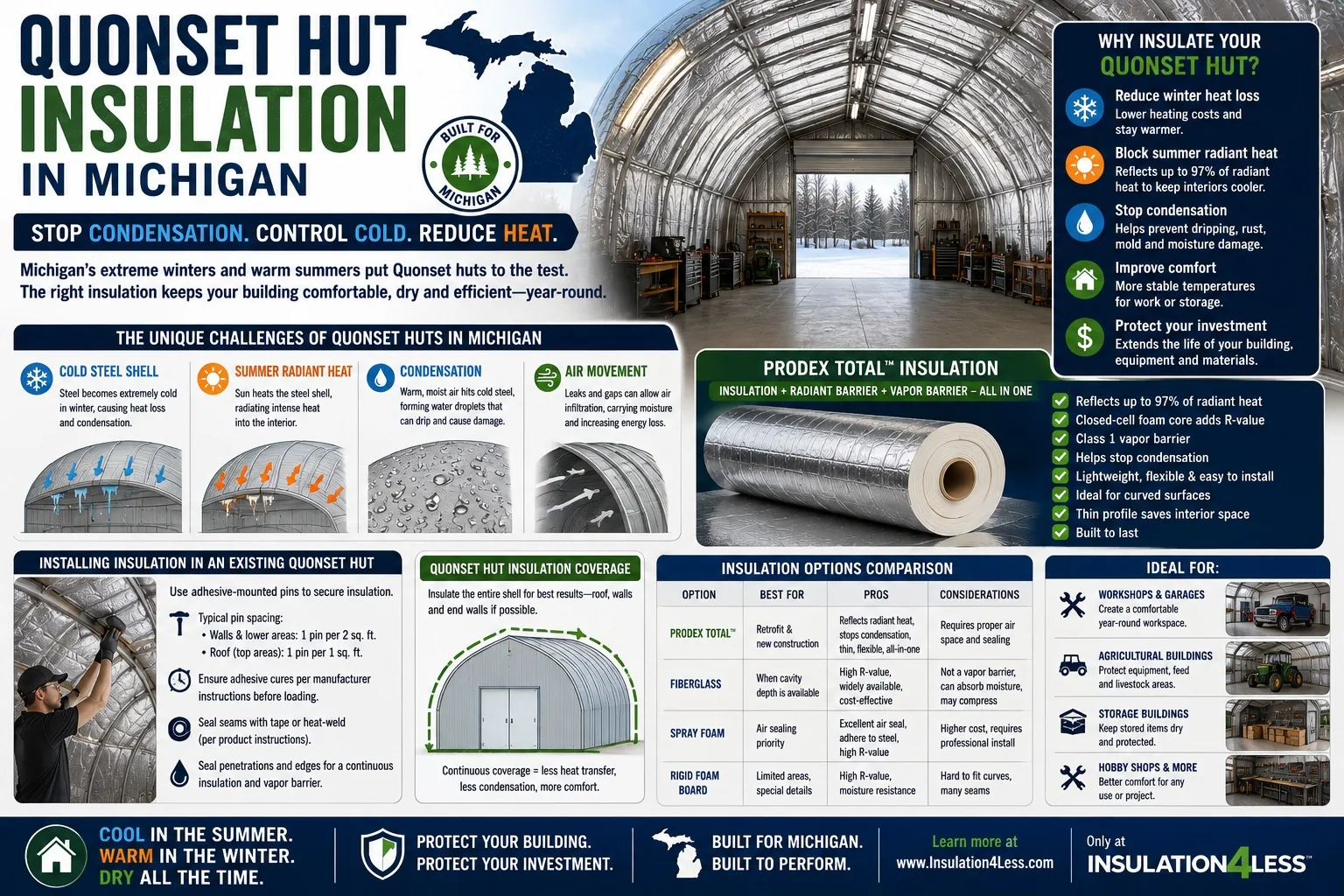
Quonset Hut Insulation in Michigan: Stop Condensation, Cold & Heat
Quonset huts are strong, economical and remarkably versatile—but their curved steel construction creates unusual insulation challenges. In Michigan, those challenges become especially important. During winter, the steel shell can become extremely cold. If a Quonset hut is heated, warm interior air containing moisture can encounter the cold metal and create condensation. During summer, the problem reverses. Direct sunlight can heat the steel shell and radiate substantial energy toward the interior.
Unlike a conventional building with separate walls and roof, a Quonset hut has a nearly continuous curved steel surface.That means the insulation system must address cold, radiant heat, condensation and air movement across almost the entire building envelope.
For detailed installation information, see our national Quonset Hut Insulation Guide.
Why Michigan Quonset Huts Need Insulation
A bare steel Quonset hut provides little resistance to exterior temperatures.
That can make an uninsulated structure:
- Extremely cold during winter
- Hot during sunny summer weather
- Difficult to heat efficiently
- Difficult to cool
- Susceptible to interior condensation
- Uncomfortable as a workshop or occupied space
The severity depends on how the building is used. An unheated equipment-storage building has different requirements from a heated workshop or garage. However, even an unheated Quonset hut can experience condensation when temperature and humidity conditions are favorable.
The Curved Steel Shell Changes Everything
Conventional buildings usually have clearly defined walls, ceilings and roofs. Quonset huts do not. Their curved steel panels typically form a continuous arch from one side of the building to the other. That creates an enormous metal surface exposed directly to outdoor temperatures and solar radiation. From an insulation standpoint, the roof and walls essentially become one continuous assembly. This is why insulating only a small portion of a Quonset hut may leave significant areas of exposed steel where heat transfer and condensation can continue.
Condensation: A Major Michigan Quonset Hut Problem
Condensation is one of the most important reasons to insulate a Quonset hut in Michigan. It occurs when moisture-containing air encounters a surface cold enough to reach the dew point. During winter, the steel shell can become extremely cold. If the interior is heated, the temperature difference between the warm interior and cold steel becomes substantial.Warm interior air reaching that steel can produce water droplets. Eventually, enough water can accumulate that it begins dripping. This is why owners sometimes describe an apparently leak-free metal building as "raining inside."
What Quonset Hut Condensation Can Damage
Repeated condensation can affect more than comfort.
Moisture may reach:
- Vehicles
- Tools
- Machinery
- Stored materials
- Electrical equipment
- Interior finishes
- Wood framing
- Personal belongings
Persistent moisture can also contribute to corrosion of metal components and mold or mildew growth on susceptible materials. The insulation system should therefore be designed with moisture management in mind—not simply thermal resistance.
Michigan Winter Heat Loss
Heating an uninsulated steel Quonset hut can be difficult. Steel readily conducts heat. When outdoor temperatures fall, the entire shell can become a large cold surface surrounding the heated interior. Heat continually moves toward the colder exterior.Insulation helps slow that transfer.
This becomes particularly important when the building is used as a:
- Workshop
- Garage
- Commercial workspace
- Hobby shop
- Agricultural work area
- Equipment-maintenance facility
The more consistently the building is heated, the more important the thermal envelope becomes.
Summer Radiant Heat
Michigan winters may receive most of the attention, but summer performance matters too. A Quonset hut exposes a large portion of its curved steel shell directly to sunlight. Solar radiation heats the exterior steel. The heated steel can then radiate energy toward the interior. This is a different heat-transfer mechanism from conduction. Reflective insulation is particularly relevant because it is designed to address radiant heat when installed with the appropriate air space. For more information, see Reflective Insulation in Michigan.
Why Reflective Insulation Works Well in Quonset Huts
Quonset huts are one of the building types where reflective insulation can make considerable practical sense.
The reasons include:
- Large metal surface area
- Significant radiant heat exposure
- Condensation potential
- Curved construction
- Limited interior space
- Need for flexible insulation
- Difficulty installing thick rigid materials around curves
A thin, flexible insulation product can follow the shape of the building more easily than many rigid insulation systems. This can simplify installation while preserving usable interior space.
Prodex Total for Michigan Quonset Huts
Prodex Total combines reflective surfaces with a closed-cell polyethylene foam core. This construction allows the insulation to address several aspects of Quonset-hut performance.
Depending on the particular product and assembly, Prodex Total can provide:
- Thermal insulation
- Radiant heat control
- Vapor-barrier performance
- Condensation control
- Air-control characteristics when properly sealed
Prodex Total = Insulation + Radiant Barrier + Vapor Barrier — All in One Product.
Its flexibility also makes it particularly well suited to the curved surfaces found inside Quonset huts.
Installing Prodex Total in an Existing Quonset Hut
Retrofit installations differ from new construction because the steel shell is already installed. One common approach is to attach insulation to the inside of the Quonset hut using an appropriate fastening system. For Prodex Total retrofit applications, adhesive-mounted pins can be used to support the insulation. Typical pin spacing depends on the location and installation.
As a general installation guideline:
- Walls and lower curved areas: approximately one pin per 2 square feet
- Roof areas: approximately one pin per square foot
- Ceiling-type applications: additional support may be required
Adhesive used for pins should be allowed to cure according to its instructions before loading it with insulation. Installation requirements can vary, so follow the instructions for the specific Prodex product and fastening system being used.
New Quonset Hut Construction
New construction offers the opportunity to plan insulation before the building is completely assembled.
This can simplify:
- Continuous insulation coverage
- Seam placement
- Air spaces
- Penetrations
- Vapor control
- Interior finishing
Planning the insulation system before construction can also help determine how the finished interior will look and how much interior space will remain available.
Don't Compress the Air Space
Reflective insulation works differently from conventional mass insulation. Its reflective surface performs best when facing an appropriate air space. Simply sandwiching reflective insulation tightly between two solid surfaces can eliminate much of the radiant-barrier benefit. The installation should therefore maintain the air space required by the specific insulation assembly. This is especially important when insulating curved Quonset hut shells.
Sealing Seams and Penetrations
Continuity matters. Open seams and penetrations can allow unwanted air and moisture movement through the insulation system.
Depending on the Prodex product, seams may be:
- Taped
- Heat-welded
- Otherwise sealed according to installation instructions
Penetrations around electrical systems, framing and other building components should also be addressed. The goal is to create as continuous an insulation and vapor-control layer as practical.
Quonset Hut Roof Insulation Is Wall Insulation Too
In conventional construction, we often emphasize insulating the roof first. That principle still applies to Quonset huts, but with an important difference. There isn't a clear point where the roof ends and the walls begin. The continuous arch means that solar exposure, winter cold and condensation can affect much of the structure. For that reason, complete coverage can be particularly valuable in a Quonset hut. For more information about roof performance, see Roof & Ceiling Insulation in Michigan.
Fiberglass Insulation in Quonset Huts
Fiberglass can provide effective conductive thermal resistance, but installing it in a curved steel building presents challenges.
Potential considerations include:
- Holding thick insulation against curved surfaces
- Preventing compression
- Maintaining complete coverage
- Controlling moisture
- Providing vapor control
- Preserving interior space
If fiberglass is used against a metal shell, the complete assembly must be designed to manage condensation. For a broader comparison, see Fiberglass Insulation vs. Prodex Total in Michigan.
Spray Foam in Michigan Quonset Huts
Spray polyurethane foam is another option sometimes considered for Quonset huts. Because it adheres directly to the metal surface, spray foam can follow the building's curved shape.
However, factors to consider include:
- Installation cost
- Surface preparation
- Required thickness
- Professional installation
- Future repairs
- Fire-protection requirements
- Difficulty removing foam from steel
The best choice depends on the building, budget and intended use.
Foam Board in Quonset Huts
Rigid foam board can provide substantial thermal resistance, but the geometry of a Quonset hut creates an obvious challenge:
Rigid boards are flat. Quonset huts are curved.
Cutting and fitting rigid panels around the shell can create considerable labor and numerous joints. Those joints must then be addressed to create a continuous insulation system. Flexible insulation can be considerably easier to conform to the building's curved geometry.
Michigan Quonset Hut Garages
Quonset huts are frequently used as garages because their open-span construction provides substantial unobstructed interior space.
Insulation becomes especially valuable if the garage is heated
It can help:
- Reduce winter heat loss
- Reduce summer radiant heat
- Control condensation
- Protect vehicles and tools
- Improve working comfort
For other metal-garage applications, see Metal Garage & Workshop Insulation in Michigan.
Quonset Hut Workshops
A Quonset hut used as a workshop generally requires greater interior comfort than a simple storage building. If people spend hours working inside, temperature control becomes more important. Workshop activities can also generate moisture. Insulation should therefore be coordinated with appropriate heating, cooling and ventilation systems.
For larger steel-building applications, see Metal Building Insulation in Michigan. Our national guide to insulation for metal buildings explains how cold, radiant heat, condensation and air movement affect steel structures.
Agricultural Quonset Huts
Quonset huts are also used for agricultural purposes.
Applications can include:
- Equipment storage
- Feed storage
- Machinery maintenance
- General farm storage
- Livestock-related uses
Moisture conditions vary dramatically according to use. Buildings containing animals or other significant moisture sources may require substantial ventilation in addition to insulation. Insulation cannot replace ventilation where ventilation is necessary.
How Much Insulation Does a Quonset Hut Need?
Calculating insulation for a Quonset hut is different from calculating material for a rectangular building. Using only the floor dimensions will underestimate the amount of material required. You need to account for the curved surface area of the shell as well as the end walls if they will be insulated.
Important measurements include:
- Building length
- Building width
- Arch dimensions
- End-wall dimensions
- Doors
- Windows
- Other openings
Our How Much Insulation Do I Need? guide provides additional material-estimating information.
Choosing Insulation for a Michigan Quonset Hut
Before choosing an insulation system, consider these questions.
Will the Quonset Hut Be Heated?
Heating increases the winter temperature difference between the interior and exterior steel and can increase condensation concerns.
Will It Be Cooled?
Summer cooling changes heat and moisture movement through the assembly.
What Will the Building Be Used For?
A storage building, workshop, garage and agricultural building have different requirements.
Is Condensation Already Occurring?
If the shell is sweating, address condensation as part of the insulation design.
How Much Interior Space Can You Sacrifice?
Thicker insulation systems reduce usable interior dimensions.
Is This New Construction or a Retrofit?
Installation methods can differ substantially.
What Do Local Codes Require?
Thermal, fire and building requirements can vary according to jurisdiction and building use. Verify applicable requirements before selecting the final assembly.
Michigan Quonset Hut Insulation for All Four Seasons
A Quonset hut may look simple from the outside, but insulating one properly requires understanding how its continuous steel shell interacts with Michigan's climate. Winter creates cold steel, heat loss and condensation potential. Summer creates solar heating and radiant heat. Moisture and uncontrolled air movement can affect performance throughout the year. An insulation system should address these conditions together.
The objective remains:
Cool in the Summer. Warm in the Winter. Dry all the Time.
With the right insulation system and installation method, a Michigan Quonset hut can become a considerably more comfortable and useful garage, workshop, agricultural building or storage space.
Explore Michigan Insulation Guides
Continue exploring insulation solutions for Michigan buildings:
- Michigan Insulation Guide
- Metal Building Insulation in Michigan
- Pole Barn Insulation in Michigan
- House Insulation in Michigan
- Roof & Ceiling Insulation in Michigan
- Fiberglass Insulation vs. Prodex Total in Michigan
- Reflective Insulation in Michigan
- Metal Garage & Workshop Insulation in Michigan
- Shipping Container Insulation in Michigan