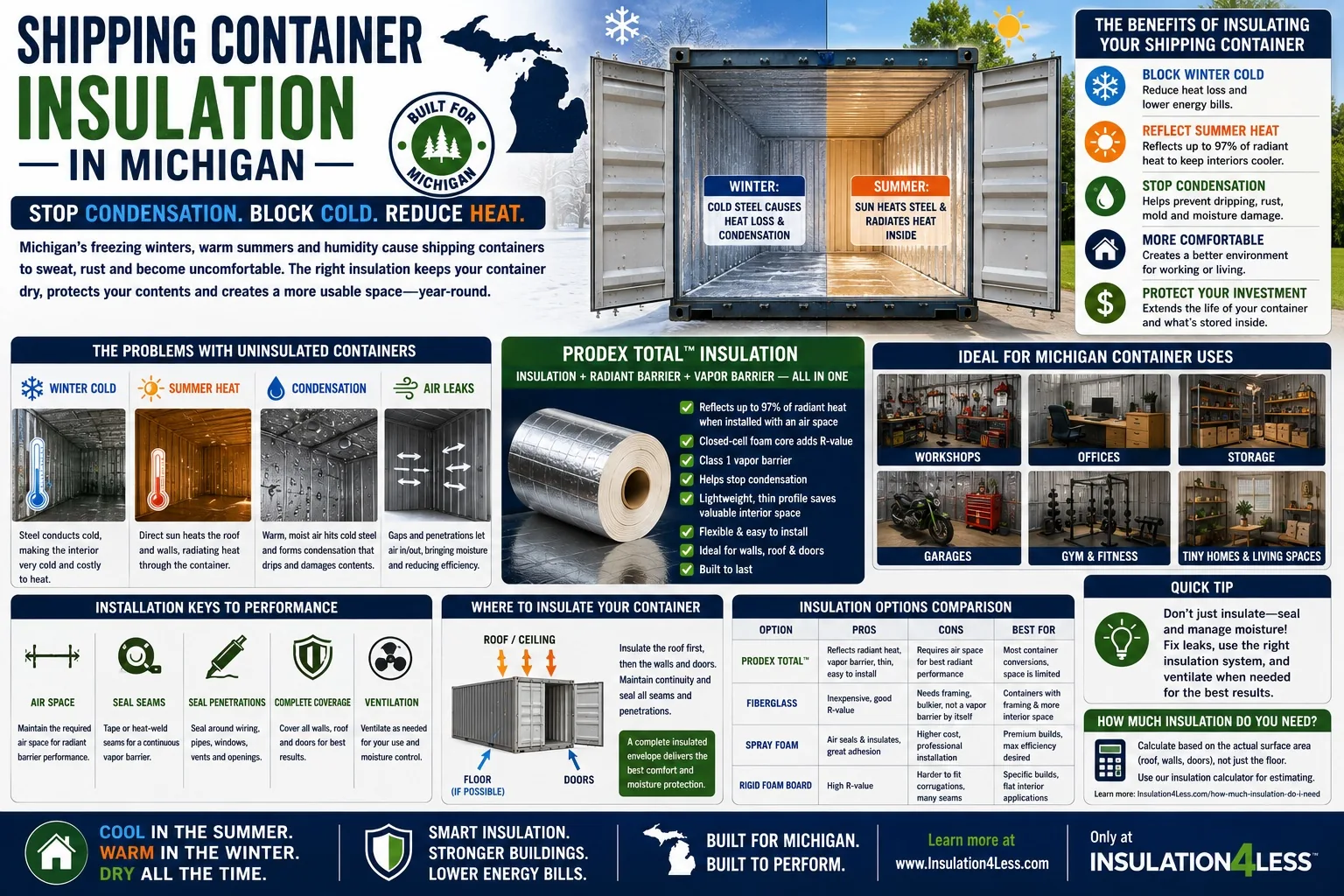
Shipping Container Insulation in Michigan: Stop Condensation, Cold & Heat
Shipping containers are exceptionally strong, portable and versatile—but they were designed to transport cargo, not to provide comfortable interior temperatures. Their corrugated steel shells readily respond to outdoor conditions. In Michigan, that means a container can become extremely cold during winter and surprisingly hot under direct summer sunlight.
There is another major challenge:
Condensation.
When warm, moisture-containing interior air encounters cold container steel, water can form on the walls and ceiling.
If you're converting a shipping container into a workshop, storage building, office, equipment room or other usable space, insulation should address cold, radiant heat, condensation, vapor and interior space together.
For a complete overview, see our national Shipping Container Insulation Guide.
Why Michigan Shipping Containers Need Insulation
A shipping container is essentially a large steel box. Steel is durable, but it conducts heat readily. Without insulation, exterior temperature changes quickly affect the interior.
Michigan containers can experience:
- Cold interior surfaces during winter
- Significant heat gain during summer
- Condensation
- Large temperature swings
- Uncomfortable working conditions
- Moisture-sensitive storage problems
Insulation helps separate the container interior from those exterior conditions.
Michigan Winter Cold
Winter presents one of the most obvious challenges. When outdoor temperatures fall, the container's steel roof and walls become cold. If the interior is heated, heat moves toward those colder exterior surfaces. Without insulation, maintaining a comfortable interior temperature can require substantially more heating. The problem isn't limited to comfort. Cold steel also increases the possibility of condensation when warm interior air contains moisture.
Why Shipping Containers Sweat
Shipping-container condensation is sometimes described as container sweat. It occurs when moisture in the air encounters steel cold enough to reach the dew point.
Water droplets may form on:
- The underside of the roof
- Side walls
- End walls
- Doors
- Metal framing
As moisture accumulates, it can eventually drip onto the floor or contents. This may happen even when the container is completely watertight from rain. The water is being generated by condensation inside the container rather than leaking through the roof.
Where Does the Moisture Come From?
Interior moisture can come from many sources.
Depending on how the container is used, these may include:
- People
- Wet vehicles or equipment
- Snow and ice
- Damp stored materials
- Ground moisture
- Combustion
- Washing
- Outdoor humid air
- Building materials
Heating the container does not remove this moisture automatically. In fact, warm interior air can hold more water vapor, which becomes important when that air reaches cold steel.
Why Condensation Matters
Repeated condensation can damage both the container and its contents.
Potential problems include:
- Corrosion
- Rusted tools
- Damaged machinery
- Wet cardboard boxes
- Damp stored materials
- Mold or mildew on susceptible materials
- Damaged interior finishes
- Moisture around electrical equipment
Insulation should therefore be considered part of a broader moisture-control strategy.
Summer Heat Inside Shipping Containers
Michigan may be known for winter, but summer performance matters too. A shipping container sitting in direct sunlight can absorb significant solar energy. The roof is particularly exposed. As the steel heats, energy moves toward the interior through conduction and radiation. Without insulation, interior temperatures can become uncomfortable very quickly. This makes the roof one of the most important surfaces to address.
Start With the Container Roof
The roof receives substantial direct solar exposure during summer. It also becomes extremely cold during winter.
That means the same surface can contribute to:
- Summer radiant heat
- Conductive heat gain
- Winter heat loss
- Condensation
If insulation priorities must be established, the container roof deserves particular attention
For additional information, see Roof & Ceiling Insulation in Michigan. Our national Roof Insulation Guide explains roof heat transfer in greater detail.
Don't Forget the Container Walls
The walls represent another large portion of the container's thermal envelope. Bare steel walls can transfer exterior temperatures directly toward the interior. During winter they can become cold enough for condensation to form. During summer, walls receiving direct sunlight can contribute additional heat. Insulating both the roof and walls creates a more complete thermal envelope than addressing one surface alone.
Why Interior Space Matters
Shipping containers have a unique insulation constraint: Every inch of insulation installed inward reduces usable interior space.
This matters especially in narrower containers.
Thick insulation assemblies can reduce:
- Interior width
- Ceiling height
- Storage capacity
- Workspace
- Clearance around equipment
This makes insulation thickness an important part of the decision. A thin insulation system can be attractive when preserving usable interior dimensions is a priority.
Reflective Insulation for Shipping Containers
Reflective insulation can be particularly useful inside steel containers. The reflective surface is designed to reduce radiant heat transfer when it faces an appropriate air space. This can help address solar energy entering through a hot steel roof or wall. A reflective insulation system can therefore contribute to summer comfort without requiring the thickness associated with some conventional insulation systems. See Reflective Insulation in Michigan for a detailed explanation.
Prodex Total for Michigan Shipping Containers
Prodex Total combines reflective surfaces with a closed-cell polyethylene foam core.
Depending on the specific product and assembly, it can provide:
- Thermal insulation
- Radiant heat control
- Vapor-barrier performance
- Condensation control
- Air-control characteristics when properly sealed
Prodex Total = Insulation + Radiant Barrier + Vapor Barrier — All in One Product.
Its thin profile is particularly useful in shipping containers because it can provide multiple building-envelope functions while conserving interior space.
Reflecting Radiant Heat
Prodex Total can reflect up to 97% of radiant heat when installed in an appropriate assembly. This can be particularly useful beneath the container roof. The reflective surface should face the appropriate air space to provide radiant-barrier performance. It is important to distinguish radiant heat from total heat transfer. The reflective surface addresses radiant energy. The foam core and complete assembly contribute to other aspects of thermal performance.
Closed-Cell Foam and Moisture
Prodex Total uses a closed-cell foam core. Closed-cell foam does not readily absorb water. This is an important characteristic in an application where condensation and moisture can be significant concerns. However, insulation should not be used simply to conceal an existing water problem. Roof leaks, door leaks and other sources of liquid water should be corrected before insulation is installed.
Vapor Control Inside a Container
Vapor control is especially important when insulating steel structures. If warm interior moisture can move through an insulation system and reach cold steel, condensation can occur behind the insulation where it may be difficult to see. A continuous vapor-control layer can help limit that moisture movement. Prodex Total can provide vapor-barrier characteristics when seams, edges and penetrations are properly treated according to the product instructions.
Air Space Is Important
Reflective insulation performs differently from conventional mass insulation. For the reflective surface to function effectively as a radiant barrier, it should face an appropriate air space. Compressing reflective insulation tightly between two solid surfaces can reduce the radiant-barrier benefit. The required installation configuration depends on the specific product and assembly. Follow applicable installation instructions.
Sealing the Insulation System
Continuity matters inside a container. Open seams and penetrations can allow air and moisture to move behind the insulation.
Depending on the specific Prodex product, seams may be:
- Taped
- Heat-welded
- Otherwise sealed according to installation instructions
Attention should also be given to:
- Corners
- Electrical penetrations
- Windows
- Doors
- Framing attachments
- Mechanical penetrations
The objective is a reasonably continuous insulation and vapor-control layer.
Fiberglass Insulation in Shipping Containers
Fiberglass can provide effective conductive thermal resistance, but containers present several challenges. Fiberglass usually requires a framing cavity to maintain its thickness. That framing and insulation can consume valuable interior space.
The complete system must also address:
- Air leakage
- Vapor control
- Moisture
- Condensation at the steel shell
- Compression
Fiberglass can work in an appropriately designed assembly, but it should not simply be placed against cold steel without considering moisture behavior. See Fiberglass Insulation vs. Prodex Total in Michigan.
Spray Foam in Shipping Containers
Spray polyurethane foam is frequently considered for container conversions because it can adhere directly to corrugated steel. Potential advantages include good air sealing and the ability to conform to irregular surfaces.
Considerations can include:
- Cost
- Required thickness
- Professional installation
- Surface preparation
- Fire-protection requirements
- Future repairs
- Difficulty removing foam from the steel
The appropriate system depends on the intended use and project requirements.
Rigid Foam Board in Shipping Containers
Rigid foam board can provide substantial thermal resistance. However, the corrugated shape of container walls creates installation challenges. Flat boards do not naturally conform to corrugated steel. Gaps may therefore develop unless the system is carefully designed and installed. Numerous seams and edges may also need to be sealed. Thickness can reduce usable interior dimensions.
Insulating a Container Workshop
Shipping containers are often converted into compact workshops. Insulation can make these spaces considerably more usable throughout the year.
A workshop may require attention to:
- Heating
- Cooling
- Ventilation
- Electrical systems
- Lighting
- Interior moisture
- Equipment clearances
Insulation should be coordinated with these systems rather than installed independently.
For larger workshop buildings, see Metal Garage & Workshop Insulation in Michigan.
Insulating Containers for Storage
A storage container may not need the same interior temperature as an occupied workshop. However, moisture control can be even more important when valuable materials remain unattended for long periods.
Items vulnerable to condensation include:
- Tools
- Machinery
- Paper products
- Furniture
- Clothing
- Electronics
- Building materials
The appropriate insulation and ventilation strategy depends partly on what is being stored.
Container Offices and Occupied Spaces
A container used as an office or regularly occupied workspace requires greater attention to interior comfort. Heating, cooling and ventilation requirements become more significant. Insulation should be designed as part of the complete building envelope and mechanical system. Local building, energy and fire codes may also impose requirements that do not apply to a container used only for storage.
Shipping Containers Are Small Metal Buildings
Many of the principles used for larger steel buildings apply directly to shipping containers.
Both have:
- Steel exterior surfaces
- High thermal conductivity
- Radiant heat exposure
- Condensation potential
- Vapor-control concerns
The major difference is scale and geometry. Containers have much less interior space to sacrifice to thick insulation assemblies.
For a broader discussion, see Metal Building Insulation in Michigan.
You can also review our national guide to insulation for metal buildings.
How Much Insulation Does a Shipping Container Need?
Material requirements depend on:
- Container length
- Container height
- Whether the roof is insulated
- Whether all walls are insulated
- End-wall treatment
- Door treatment
- Windows and openings
Common container sizes include 20-foot and 40-foot units, but actual surface area should be calculated from the dimensions of the surfaces being covered. Do not calculate insulation requirements using floor square footage alone.
See How Much Insulation Do I Need? for additional estimating guidance.
Choosing Shipping Container Insulation in Michigan
Before selecting insulation, answer several questions.
What Will the Container Be Used For?
Storage, workshops and occupied spaces have different requirements.
Will It Be Heated?
Heating increases winter heat-transfer and condensation considerations.
Will It Be Air-Conditioned?
Cooling changes heat and moisture movement during summer.
Is Condensation Already Occurring?
Identify moisture sources before covering the steel.
How Much Interior Space Can You Sacrifice?
Thick assemblies reduce usable dimensions.
Do You Need a Vapor Barrier?
The complete wall and roof assembly should be evaluated for moisture movement.
Can You Maintain the Required Air Space?
Reflective insulation requires the appropriate installation configuration to provide radiant-barrier performance.
What Do Local Codes Require?
Converted containers may be subject to building, energy, fire, structural and occupancy requirements. Verify applicable requirements with the appropriate Michigan building officials.
Michigan Shipping Container Insulation for All Four Seasons
Michigan's climate exposes shipping containers to two very different temperature extremes. Winter can produce cold steel, heat loss and condensation. Summer sunlight can create substantial roof and wall temperatures and radiant heat. Because containers provide limited interior space, the insulation system must also balance thermal performance with thickness.
The goal is:
Cool in the Summer. Warm in the Winter. Dry all the Time.
A well-designed insulation system can transform a bare steel container into a more useful workshop, storage building or occupied space while helping protect both the structure and its contents.
Explore Michigan Insulation Guides
This completes the Michigan insulation cluster. Explore all of the Michigan guides:
- Michigan Insulation Guide
- Metal Building Insulation in Michigan
- Pole Barn Insulation in Michigan
- House Insulation in Michigan
- Roof & Ceiling Insulation in Michigan
- Fiberglass Insulation vs. Prodex Total in Michigan
- Quonset Hut Insulation in Michigan
- Reflective Insulation in Michigan
- Metal Garage & Workshop Insulation in Michigan
- Shipping Container Insulation in Michigan