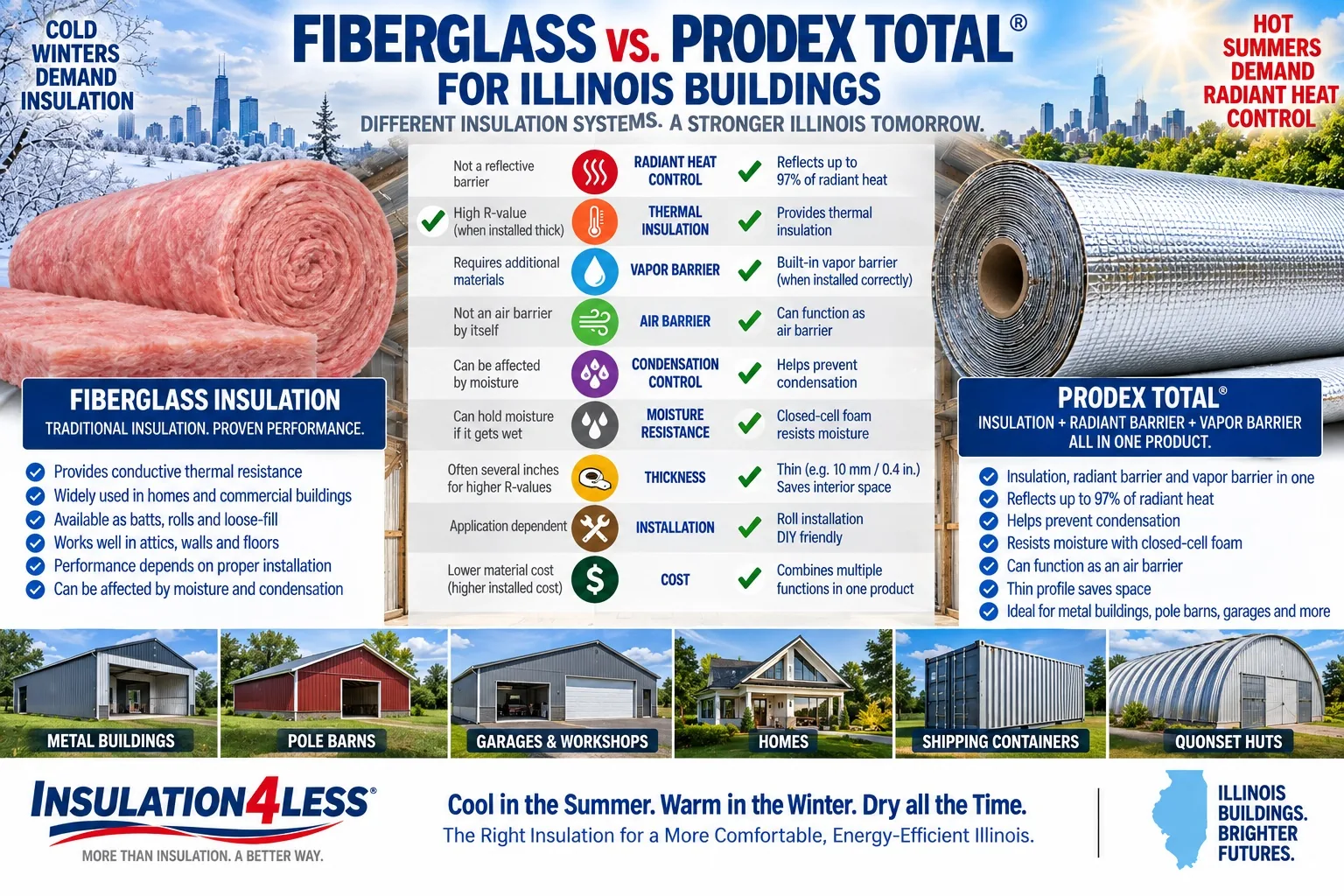
Fiberglass vs. Prodex Total in Illinois: Which Insulation Is Right for Your Building?
Fiberglass and Prodex Total are very different insulation systems. Both can reduce heat transfer, and both can be useful in Illinois buildings, but they accomplish that job differently.
Fiberglass primarily provides resistance to conductive heat flow.
Prodex Total combines closed-cell insulation with reflective surfaces and can provide thermal insulation, radiant heat control, air-barrier and vapor-barrier functions in one product when installed correctly.
That distinction becomes particularly important in Illinois metal buildings, pole barns, garages and workshops, where insulation must often address not only winter cold but also summer radiant heat and condensation against steel roof and wall panels.
This guide compares the two systems so you can determine which approach is appropriate for your project.
For statewide insulation information, start with our Illinois Insulation Guide.
For a broader national comparison, see Prodex Total vs. Fiberglass for Metal Buildings.
Prodex Total = Insulation + Radiant Barrier + Vapor Barrier — All in One Product.
Fiberglass and Prodex Total Solve Different Problems
It is tempting to compare insulation products using only one number: R-value.
But buildings lose and gain heat in several ways.
Heat moves through:
- Conduction
- Radiation
- Air movement
Moisture also moves through air and vapor diffusion and can create condensation when warm, moisture-containing air reaches cold surfaces. Fiberglass primarily addresses conductive heat transfer. Prodex Total is designed to address several mechanisms simultaneously. That is why the right comparison is not simply:
Which product has the bigger R-value?
The better question is:
What problems does my building need the insulation system to solve?
What Is Fiberglass Insulation?
Fiberglass insulation is manufactured from fine glass fibers and is commonly sold as:
- Batts
- Rolls
- Loose-fill insulation
- Metal-building insulation blankets
It has been used in residential and commercial construction for decades and can provide substantial conductive thermal resistance. For metal-building applications, fiberglass blankets are often installed beneath exterior steel panels and may include a facing material. For more information about fiberglass specifically used in steel structures, see our Fiberglass Metal Building Insulation Guide.
What Is Prodex Total?
Prodex Total Insulation uses a closed-cell polyethylene foam core between reinforced reflective surfaces.
Depending on the product and installation, Prodex Total can provide:
- Thermal insulation
- Radiant heat reflection
- Vapor barrier
- Air barrier
- Condensation control
- Moisture resistance
- Mold and mildew resistance
- Sound dampening
The reflective surfaces can reflect up to 97% of radiant heat when installed with an appropriate adjacent air space. The closed-cell foam does not absorb water like fibrous insulation can. These characteristics make Prodex Total particularly useful in buildings where metal surfaces, radiant heat and condensation are important concerns.
Fiberglass vs. Prodex Total: Conductive Heat
Fiberglass is designed primarily to resist conductive heat transfer. The thicker the properly installed fiberglass layer, the greater its potential conductive thermal resistance. This is one reason fiberglass remains common where high assembly R-values are required. Prodex Total also provides conductive thermal resistance, but its performance should not be evaluated solely by comparing thickness with thick fiberglass blankets. Prodex Total also addresses radiant heat, air movement and vapor movement. In some applications, these additional functions can be just as important as conductive R-value.
Fiberglass vs. Prodex Total: Radiant Heat
Radiant heat is especially important in metal buildings. During an Illinois summer, sunlight can heat metal roofing substantially. The hot metal can then radiate energy toward cooler surfaces inside the building. Fiberglass slows conductive heat transfer but is not itself a reflective radiant barrier. Prodex Total has reflective surfaces designed to reduce radiant heat transfer when facing an appropriate air space.
For additional information about how this works, see our Reflective Insulation Guide.
This can be particularly valuable in:
- Metal buildings
- Pole barns
- Metal garages
- Workshops
- Agricultural buildings
- Quonset huts
- Shipping containers
Fiberglass vs. Prodex Total: Condensation
This may be the most important difference for many Illinois steel buildings. During winter, metal roof and wall panels can become very cold. Warm interior air contains moisture. If that air reaches sufficiently cold metal, water vapor can condense into liquid water. Fiberglass does not inherently prevent moisture-containing air from reaching the steel. If fiberglass becomes wet, its performance can be affected and moisture may remain trapped within the assembly. Prodex Total can function as a vapor barrier and air barrier when properly installed with sealed seams.That helps isolate warm interior air from cold exterior steel. For a complete discussion of this problem, see our national Metal Building Insulation Guide.
For Illinois-specific information, see Illinois Metal Building Insulation.
Fiberglass vs. Prodex Total: Moisture Resistance
Fiberglass itself is made from glass fibers, but the complete fiberglass insulation system can still be affected by moisture. Water can occupy the air spaces within fibrous insulation, and wet surrounding materials can create additional problems. Prodex Total uses a closed-cell polyethylene foam core that resists moisture. That makes it particularly useful where condensation and moisture are important considerations. However, neither insulation product should be used to cover an active roof leak, plumbing leak or other source of bulk water.
Fix the water source first.
Fiberglass vs. Prodex Total: Air Leakage
Air leakage can significantly affect building performance. Even a high-R insulation layer can perform poorly if conditioned air moves freely around or through gaps in the assembly. Fiberglass is not inherently an air barrier. Air-control performance depends on surrounding construction and dedicated air-barrier materials. Prodex Total can function as an air barrier when installed continuously and when seams and penetrations are properly sealed.
This can be particularly useful in open-framed metal buildings and pole barns.
Fiberglass vs. Prodex Total: Thickness
Fiberglass commonly requires substantial thickness to achieve higher R-values. That can be perfectly acceptable in conventional framed walls, attics or purpose-designed metal-building assemblies. Prodex Total is much thinner.
For example, 10M Prodex Total Plus is approximately 10 mm, or 0.4 inch, thick.
That thin profile can be useful where interior space is valuable or thick insulation is difficult to install.
Examples include:
- Shipping containers
- Quonset huts
- Retrofit metal buildings
- Workshops
- Garages
Thickness alone should not determine which product is appropriate.
The performance of the complete assembly matters.
Fiberglass vs. Prodex Total in Illinois Metal Buildings
Metal buildings create conditions where the differences between the two products become particularly important. Steel efficiently conducts heat. During summer, the roof can become a significant source of radiant heat. During winter, cold steel surfaces can create condensation risks. Fiberglass can provide substantial conductive thermal resistance. Prodex Total can provide thermal insulation while also addressing radiant heat, air movement and vapor movement. For many Illinois metal buildings, these products can also be used together rather than treated as mutually exclusive choices.
See Illinois Metal Building Insulation for the complete state-specific application.
Fiberglass vs. Prodex Total in Illinois Pole Barns
Pole barns and post-frame buildings can be used for everything from agricultural storage to heated workshops and commercial spaces. The appropriate insulation depends heavily on how the building will be used. For an unheated agricultural structure, condensation and summer radiant heat may be major concerns. For a heated workshop, substantially greater thermal resistance may be required. Prodex Total can be used alone in appropriate applications or combined with fiberglass where additional thermal resistance is needed. See our Illinois Pole Barn Insulation Guide.
For national information, see Pole Barn Insulation.
Fiberglass vs. Prodex Total in Garages and Workshops
An Illinois garage or workshop may experience:
- Summer radiant heat
- Winter heat loss
- Condensation
- Vehicle moisture
- Humidity generated by work activities
A detached metal garage can behave very differently from a conventionally framed residential garage. Prodex Total is particularly useful in metal garages because it can address radiant heat and condensation along with thermal insulation. Fiberglass may provide additional thermal resistance when the garage will be continuously heated.
See Illinois Metal Garage Insulation for the complete application guide.
Fiberglass vs. Prodex Total for Roof Insulation
Roofs are exposed to intense solar radiation and large temperature differences. Fiberglass is commonly used in attic and roof assemblies because it provides conductive thermal resistance. Prodex Total adds a different capability: reflective radiant-heat control. When Prodex faces an appropriate air space, the reflective surface can reduce radiant energy moving from a hot roof toward the interior. The two materials can therefore complement one another in appropriate roof assemblies. For Illinois applications, see Illinois Roof Insulation. For broader information, see our national Roof Insulation Guide.
Fiberglass vs. Prodex Total in Illinois Homes
Residential buildings often need different insulation materials in different areas.
Fiberglass may work well in:
- Attics
- Wall cavities
- Ceilings
- Floor systems
Prodex Total may be useful in appropriate:
- Roof assemblies
- Wall assemblies
- Basements
- Crawl spaces
- Remodeling projects
There is no rule requiring the entire house to use one type of insulation. The goal is to create an effective building envelope. For complete residential information, see Illinois House Insulation.
Can You Use Fiberglass and Prodex Total Together?
Yes.
This is important because customers sometimes assume they must choose one product and reject the other. In many applications, they perform complementary functions. Fiberglass can provide additional conductive thermal resistance.
Prodex Total can contribute:
- Radiant heat control
- Vapor control
- Air control
- Condensation protection
- Additional thermal resistance
For metal buildings, Prodex can be positioned between fiberglass and exterior metal in an appropriate assembly to help keep condensation from reaching the fiberglass. The R-values of insulation layers may contribute to the overall thermal resistance of an assembly, but the complete assembly and test conditions matter. When a specific code-required R-value is necessary, verify the proposed assembly with the appropriate building official or design professional.
What Happens When Fiberglass Gets Wet?
Fiberglass insulation depends heavily on trapped air within its fibers. When moisture occupies that space or surrounding components become wet, the performance and durability of the complete assembly can suffer. Wet insulation can also be difficult to dry when trapped inside enclosed construction. This is particularly important in metal buildings, where condensation may repeatedly expose an improperly designed fiberglass system to moisture. Prodex Total's closed-cell construction can help separate fiberglass from exterior metal and contribute vapor control when correctly installed.
Does Prodex Total Replace Fiberglass?
Sometimes. But not always. For many garages, agricultural buildings, workshops, storage buildings and other applications, Prodex Total may provide the performance the owner needs by itself. Other buildings require higher total thermal resistance. In those cases, fiberglass or another insulation material can supplement Prodex Total.
This is why we recommend choosing insulation based on the building and application, not simply asking which product is universally better.
What About Spray Foam?
Spray polyurethane foam provides another insulation option, particularly in metal and post-frame buildings. Closed-cell spray foam can provide substantial thermal resistance per inch and effective air sealing.
However, the comparison should also include:
- Installed cost
- Professional labor
- Application equipment
- Future repairs
- Adhesion directly to steel panels
- Radiant heat
- Moisture and condensation
- DIY feasibility
For a complete comparison, see Spray Foam Insulation for Metal Buildings & Pole Barns.
Fiberglass vs. Prodex Total Installation
Installing Fiberglass
Fiberglass installation varies considerably depending on the product. Residential batts may fit between studs or joists. Metal-building fiberglass blankets can be installed as part of a roof or wall assembly. Proper installation is critical. Gaps, compression and poorly fitted sections can reduce thermal performance.
Installing Prodex Total
Prodex Total is supplied in rolls and can be installed across or between framing depending on the application.
Installation methods vary for:
- New construction
- Existing buildings
- Walls
- Roofs
- Pole barns
- Quonset huts
- Shipping containers
- Crawl spaces
- Basements
Our Insulation Installation Guides provide application-specific instructions. For metal-building applications, maintaining the appropriate air space and properly sealing seams are especially important.
Fiberglass vs. Prodex Total Cost
Cost comparisons should be based on the complete installed insulation system, not simply material price per square foot.
Fiberglass costs can include:
- Insulation material
- Facing
- Vapor-control materials
- Installation labor
- Equipment
- Additional air sealing
Prodex Total combines several functions into one product and is designed for relatively straightforward roll installation. For contractors and DIY customers, labor requirements can significantly affect final project cost. The lowest material price does not necessarily result in the lowest total installed cost.
Fiberglass vs. Prodex Total Comparison
| Consideration | Fiberglass | Prodex Total |
|---|---|---|
| Conductive insulation | Strong | Yes |
| Radiant heat control | No reflective surface by itself | Yes |
| Vapor barrier | Requires appropriate system/facing | Yes when properly installed |
| Air barrier | No by itself | Yes when properly sealed |
| Condensation control | Depends on complete assembly | Major design function |
| Moisture | Complete system can be affected | Closed-cell foam resists moisture |
| Thickness | Often several inches | Very thin |
| Curved structures | Can be difficult depending on system | Flexible roll |
| DIY installation | Application dependent | Frequently suitable |
| Can combine with other insulation | Yes | Yes |
Which Is Better for an Illinois Metal Building?
The answer depends on how the building will be used. For a building where the primary concerns are:
Radiant heat + condensation + air + vapor
Prodex Total may address those concerns more directly. For a building requiring very high conductive thermal resistance, fiberglass may be useful. For a conditioned Illinois metal building requiring both, an appropriately designed combination of Prodex Total and fiberglass may provide the desired combination of functions.
Which Is Better for an Illinois Pole Barn?
Again, building use determines the answer. For storage and agricultural applications, condensation and radiant heat may be dominant concerns. For a continuously heated shop or occupied building, higher total thermal resistance may become more important. Prodex Total can address metal-building-specific problems involving radiant heat, condensation, air movement and vapor movement. Fiberglass can supplement the system when additional thermal resistance is required.
Which Is Better for an Illinois Home?
Most homes use multiple insulation systems. Fiberglass may be appropriate in attic and wall cavities. Prodex Total may complement those systems in roof, wall, crawl-space, basement or other appropriate assemblies. There is rarely a good reason to force one insulation product into every area of a house. The objective is to create the most effective complete envelope.
How Much Insulation Do I Need?
Material quantities depend on:
- Building dimensions
- Roof slope
- Wall height
- Areas being insulated
- Roll width
- Installation direction
- Openings
- Overlaps
Use our Advanced Insulation Calculator to estimate the amount of Prodex Total required. For additional guidance, see How Much Insulation Do I Need?.
Illinois Building-Code Considerations
Illinois insulation requirements depend on factors such as:
- Building type
- Occupancy
- Heating and cooling
- Roof assembly
- Wall assembly
- Foundation
- Location
- Applicable energy code
An individual product R-value does not automatically establish compliance for an entire building assembly. For regulated construction, verify requirements with the appropriate local building official, architect, engineer or other qualified building professional before purchasing.
Frequently Asked Questions: Fiberglass vs. Prodex Total
Is Prodex Total better than fiberglass?
They perform different functions. Fiberglass is primarily conductive insulation. Prodex Total combines thermal insulation with radiant heat, air and vapor control. The appropriate choice depends on the building and application.
Does Prodex Total have an advantage in metal buildings?
Metal buildings can have significant radiant-heat and condensation concerns. Prodex Total addresses those issues in addition to providing thermal insulation.
Can Prodex Total and fiberglass be installed together?
Yes. The two products can complement one another in appropriately designed assemblies. Fiberglass can add conductive thermal resistance while Prodex contributes radiant, air and vapor control.
Can Prodex Total help keep fiberglass dry?
In an appropriately designed metal-building assembly, Prodex positioned between exterior metal and fiberglass can help prevent condensation from reaching the fiberglass.
Does fiberglass stop radiant heat?
Fiberglass primarily slows conductive heat transfer. It does not provide the reflective surface of a radiant barrier.
Does Prodex Total reflect radiant heat?
Yes. Prodex Total can reflect up to 97% of radiant heat when its reflective surface faces an appropriate air space.
Does fiberglass act as an air barrier?
Fiberglass itself is not an air barrier. Air-control performance depends on the other components of the assembly.
Is Prodex Total waterproof?
Prodex uses closed-cell polyethylene foam that resists moisture, but insulation is not a substitute for repairing roof leaks or other sources of bulk water.
Is spray foam another option?
Yes. Spray foam can provide thermal resistance and air sealing. See our Spray Foam Insulation Guide for a detailed comparison.
Which insulation is easier to install?
It depends on the building. Prodex Total is supplied in lightweight rolls and is commonly installed by contractors and DIY customers. Fiberglass installation varies by product and assembly.
Can I use Prodex Total in addition to existing fiberglass?
Often, yes, but the existing assembly should be evaluated first. Make sure there is no trapped moisture and consider how air and vapor will move through the completed assembly.
Related Illinois Insulation Guides
Illinois Insulation Guide — The main statewide resource for Illinois insulation applications.
Illinois Metal Building Insulation — Insulation for steel buildings exposed to Illinois heat, cold and condensation.
Illinois Pole Barn Insulation — Insulation strategies for Illinois post-frame and agricultural buildings.
Illinois Metal Garage Insulation — Insulation for garages, workshops and other metal workspaces.
Illinois Roof Insulation — Roof and ceiling insulation for Illinois buildings.
Illinois Shipping Container Insulation — Insulation for steel containers exposed to heat, cold and condensation.
Illinois Quonset Hut Insulation — Insulation for curved steel Quonset structures.
Illinois Under-Slab Insulation — Insulation for concrete floors and radiant-heated slabs.
Illinois House Insulation — Whole-home insulation guidance for Illinois roofs, walls, basements, crawl spaces and floors.
Choosing the Right Illinois Insulation System
The fiberglass-versus-Prodex question does not always require choosing a winner.
Fiberglass is excellent at one important job:
Providing conductive thermal resistance.
Prodex Total is designed to address several additional building-envelope challenges:
Insulation + Radiant Barrier + Vapor Barrier + Air Barrier + Condensation Control.
For some Illinois buildings, Prodex Total alone may provide the performance required. For others, combining Prodex Total with fiberglass can provide a stronger overall insulation system. The key is matching the insulation system to the building.
For metal buildings, continue to our Metal Building Insulation Guide.
For pole barns, see Pole Barn Insulation.
For residential applications, see House Insulation.
For material quantities, use the Advanced Insulation Calculator.
Cool in the Summer. Warm in the Winter. Dry all the Time.
One Solution to Heat, Cold and Condensation — Prodex Total