Quonset Hut Insulation in Illinois: Stop Heat, Cold & Condensation
Quonset huts are durable, efficient steel structures—but their curved metal shells create a unique insulation challenge.
Unlike a conventional building where walls and roof are separate assemblies, the curved steel shell of a Quonset hut functions as both the roof and the walls. That creates a large continuous metal surface exposed directly to Illinois weather.
During summer, sunlight heats the steel shell and can radiate that heat toward the interior. During winter, the same metal rapidly transfers heat toward the cold outdoors. When warm, moisture-containing interior air reaches cold steel, condensation can form on the inside of the building.
The insulation system therefore needs to address more than R-value.
It should help control:
- Summer radiant heat
- Winter heat loss
- Condensation
- Air movement
- Vapor movement
- Moisture
- Temperature swings
For installation instructions specifically developed for these curved structures, see How to Install Quonset Hut Insulation.
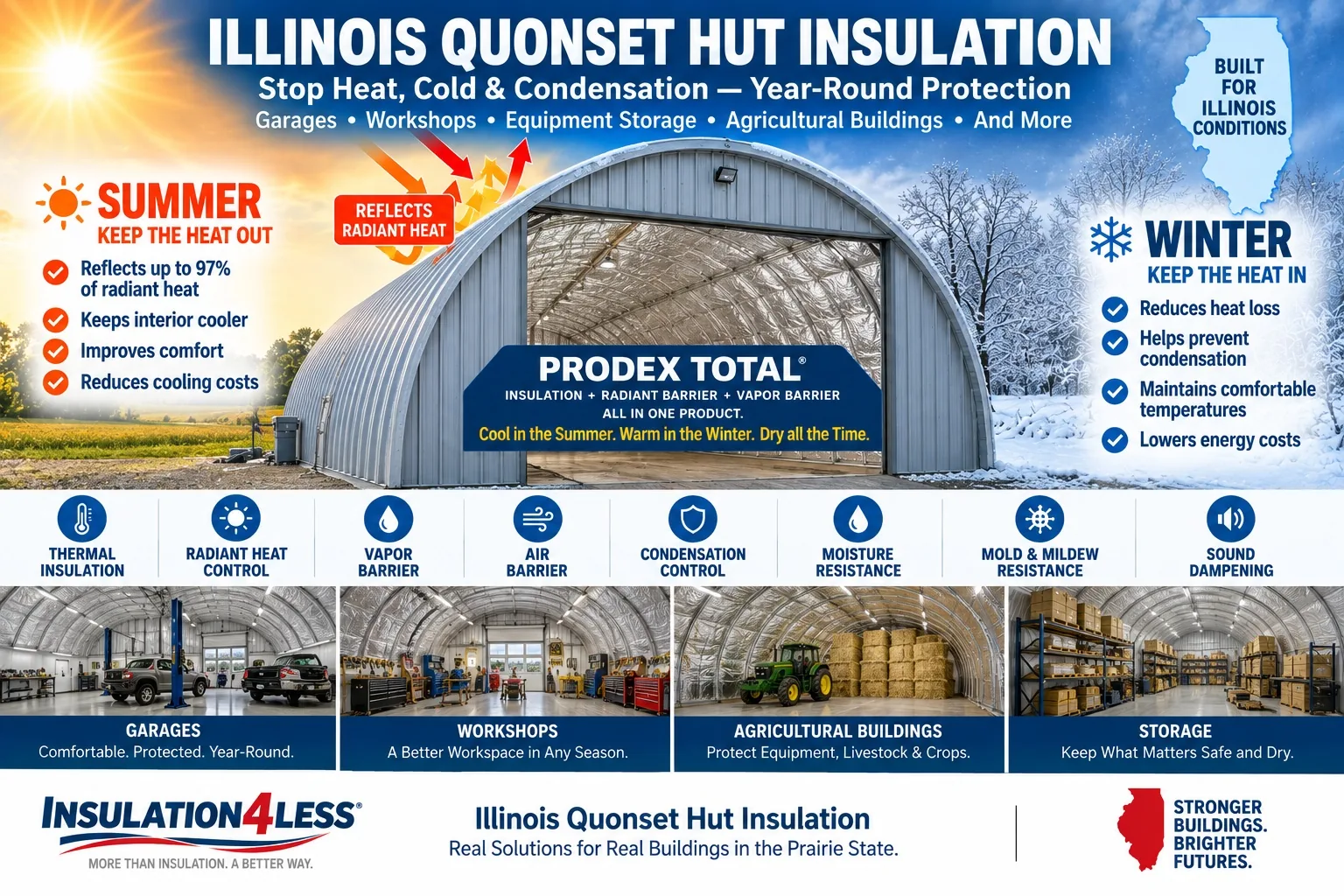
Prodex Total = Insulation + Radiant Barrier + Vapor Barrier — All in One Product.
Cool in the Summer. Warm in the Winter. Dry all the Time.
Why Illinois Quonset Huts Are Difficult to Insulate
Quonset huts behave differently from conventional wood-framed buildings. The curved metal shell efficiently transfers heat. There may be few conventional wall or ceiling cavities where traditional insulation can simply be placed between studs or joists. The shape also means that a large percentage of the building envelope is directly exposed to sunlight, cold temperatures and changing weather conditions.
Illinois adds significant seasonal variation.
A Quonset building used as an equipment shed may need basic temperature and condensation control. A heated workshop, garage or commercial building can have much greater insulation requirements because heating the interior increases the temperature difference across the steel shell. For a broader overview of insulation for buildings throughout the state, see our Illinois Insulation Guide.
Summer Heat Inside an Illinois Quonset Hut
The curved metal shell of a Quonset hut can absorb solar energy throughout the day. As the steel becomes hot, energy moves toward the cooler interior through both conduction and radiation. That is why an uninsulated Quonset hut can become extremely uncomfortable during summer even when outdoor air temperatures don't appear extreme. This is also where reflective insulation can provide an important advantage.
Prodex Total reflects up to 97% of radiant heat when installed in the appropriate assembly with an adjacent air space. The reflective surface helps reduce radiant energy traveling from the hot metal shell toward the interior. For a steel structure with such a large exposed metal surface, radiant heat control can be particularly important.
Winter Heat Loss in an Illinois Quonset Hut
Winter reverses the heat-flow problem. If the Quonset hut is heated, interior heat naturally moves toward the colder exterior. Steel readily conducts that heat. Without effective insulation, maintaining comfortable temperatures inside a workshop, garage or other conditioned Quonset building can become difficult. Insulation helps separate the heated interior from the cold steel exterior.
But thermal performance isn't the only concern.
As the exterior steel becomes cold, condensation becomes increasingly important.
Why Quonset Huts Develop Condensation
Condensation occurs when moisture-containing air reaches a surface cold enough for water vapor to condense. In an Illinois winter, the steel shell can become extremely cold. If warmer interior air reaches that metal surface, droplets can form on the inside of the shell.
That moisture can eventually:
- Drip onto equipment
- Wet stored materials
- Encourage corrosion
- Damage interior finishes
- Contribute to mold or mildew conditions
- Reduce the usefulness of the building
This problem can become more noticeable after a previously unheated Quonset hut is converted into a heated workshop or occupied space. Adding heat without addressing air and vapor movement can increase the temperature difference between the interior and exterior. This is why Quonset hut condensation cannot be addressed by R-value alone.
For a broader explanation of condensation in steel structures, see our national Metal Building Insulation Guide. Metal buildings must address conductive heat, radiant heat, air leakage, thermal bridging and moisture as a system.
Why Prodex Total Works Well in Quonset Huts
Prodex Total Insulation is particularly useful for Quonset buildings because it is flexible rather than rigid. That matters when the building envelope is curved. Prodex Total combines reinforced reflective foil surfaces with a closed-cell polyethylene foam center.
Depending on the product and installation, it can provide:
- Thermal insulation
- Radiant heat control
- Vapor barrier
- Air barrier
- Condensation control
- Moisture resistance
- Mold and mildew resistance
- Sound dampening
Rather than attempting to fit rigid insulation to every portion of a curved shell, Prodex can follow the building's geometry and create a continuous interior insulation layer. The result is essentially a protected interior envelope inside the exterior steel shell.
What Is the Best Insulation for a Quonset Hut in Illinois?
There is no single insulation system appropriate for every Quonset building. Building use matters. A basic agricultural storage building has different requirements from a heated fabrication shop. A garage may have different humidity and temperature conditions from a commercial workspace. Common options include reflective insulation, spray foam, fiberglass and rigid foam.
Prodex Total Reflective Insulation
For many Quonset applications, Prodex Total offers a particularly useful combination because it addresses several problems simultaneously. Its closed-cell foam provides thermal insulation. Its reflective surfaces reduce radiant heat transfer when facing an appropriate air space. Its air- and vapor-barrier characteristics help control the movement of moisture-containing air toward cold exterior steel. The product is also flexible enough to work with the curved profile of the structure.
Spray Foam Insulation
Spray polyurethane foam is another insulation sometimes considered for Quonset huts because it can conform to curved and irregular surfaces. Closed-cell spray foam can provide high thermal resistance per inch and good air sealing. However, spray foam should be evaluated as a complete installed system rather than simply by R-value. Professional installation may be appropriate for large steel buildings, and foam adhered directly to steel panels can complicate future repairs or replacement. Spray foam also primarily addresses conductive heat and air leakage; metal buildings still need consideration of radiant heat, condensation and thermal bridging.
Before deciding, see our complete Spray Foam Insulation Guide, which covers costs, R-values, open-cell versus closed-cell foam, DIY considerations, metal-building applications and comparisons with other insulation systems.
Fiberglass Insulation
Fiberglass can provide substantial conductive thermal resistance and may be incorporated into some Quonset insulation systems. However, fiberglass alone does not automatically provide the continuous radiant, air and vapor-control functions needed in many metal-building assemblies. Moisture is also an important consideration. Prodex Total can complement fiberglass in an appropriately designed assembly by helping separate fiberglass from exterior metal while contributing radiant and vapor control.
For additional information, see our Fiberglass Metal Building Insulation Guide.
Rigid Foam Board
Rigid foam can provide substantial thermal resistance, but the curved shell of a Quonset hut creates an obvious installation challenge. Rigid panels naturally want to remain flat. Fitting them to a curved steel structure can require cutting numerous sections and carefully sealing the resulting joints.
For a complete comparison of EPS, XPS, polyiso and alternative systems, see our Foam Board Insulation Guide.
Insulating the Curved Roof and Walls as One System
One of the biggest mistakes when thinking about Quonset insulation is applying conventional building terminology too literally. Where exactly does the roof end and the wall begin? On a traditional rectangular building, that's obvious. On a Quonset hut, the curved steel shell transitions continuously from one side of the building, over the top, and down the other side.
This means the insulation strategy should generally treat the curved shell as a continuous building envelope.
That can help reduce:
- Gaps in insulation
- Air leakage
- Vapor movement
- Thermal weak points
- Condensation-prone exposed steel
The goal is continuity.
How to Insulate an Existing Quonset Hut
Existing Quonset huts are commonly insulated from the interior.Insulation4Less has a dedicated installation method for this application. The Quonset Hut Insulation Installation Guide explains the materials, attachment method and quantity-estimation process for Prodex Total installations. For retrofit installations where conventional fastening isn't appropriate, Prodex can be supported using insulation pins and caps attached to the metal with Super Metal Sealant. The pins support the insulation without requiring the insulation itself to conform rigidly to every corrugation in the shell.
Recommended Pin Spacing
For Quonset retrofit installations, our general guidance is:
Walls: approximately 1 pin per 2 sq. ft.
Roof: approximately 1 pin per sq. ft.
Ceiling/overhead areas: use additional support where required.
Allow the sealant approximately 24 hours to cure before loading the pins with insulation.
Follow the complete Quonset Hut installation instructions for your project rather than relying on spacing alone.
Insulating a New Quonset Hut
New construction can provide additional flexibility because insulation can be incorporated as the building is assembled. The exact method depends on the Quonset manufacturer's framing and panel system. The objective remains the same: Create a continuous insulation envelope while preserving the appropriate air space for reflective performance and controlling air and vapor movement.
Because Quonset building systems vary, review the building manufacturer's installation requirements along with the Insulation4Less Quonset Hut Insulation Guide before beginning.
Does Quonset Hut Insulation Need an Air Gap?
For reflective performance, yes.
A reflective surface reduces radiant heat transfer when it faces an adjacent air space. If reflective foil is sandwiched tightly between solid materials with no air space, it cannot provide the same radiant-barrier benefit. This distinction is especially important in a Quonset hut because radiant heat from the large curved steel shell can be a major summer heat source. Where applicable, maintaining approximately 3/4 inch to 1 inch or more of adjacent air space helps provide the conditions needed for reflective performance.
Recommended Prodex Total for Illinois Quonset Huts
For many Illinois Quonset applications, 10M Prodex Total Plus is our premium recommendation.
10M Plus is:
10 mm (0.4 inch) thick
4 ft × 85.3 ft
341 sq. ft. per roll
It consists of reflective reinforced foil on both sides of a closed-cell polyethylene foam center. 10M also incorporates a heat-seal edge. Adjacent rolls can be heat-welded to create an impermeable overlapping mechanical seam without conventional seam tape. That can be particularly useful in a Quonset building because continuity of the interior air and vapor-control layer is important for condensation prevention.
Why Wider Insulation Rolls Can Help
Every seam represents an area that must be properly joined. Depending on the Quonset dimensions and framing, wider Prodex Total rolls can reduce the number of seams required across the curved shell. Prodex Total is available in multiple widths, allowing the installer to select a configuration appropriate for the building.
When planning the installation, consider not just square footage but also:
- Direction of installation
- Framing spacing
- Curved surface dimensions
- Number of seams
- Attachment points
- Openings and penetrations
Reducing unnecessary seams can simplify installation and help maintain a more continuous interior barrier.
How Much Quonset Hut Insulation Do I Need?
Do not estimate a Quonset hut simply by multiplying conventional wall height by building length. The curved shell creates more surface area than a straight-wall structure. Our Advanced Insulation Calculator can help estimate the number of rolls required. The calculator accepts building dimensions and produces an approximate roll quantity. For a Quonset hut, our installation guidance recommends estimating what the wall height would be if the structure were a straight-wall building and using that information with the calculator. Because Quonset dimensions and curves vary, allow for the actual installation layout, cuts and overlaps when ordering.
Quonset Hut Garages and Workshops
Many Illinois Quonset buildings are used as garages, repair shops, fabrication spaces or workshops. These applications make insulation particularly valuable because people may spend hours inside the structure. Summer radiant heat can make an uninsulated steel building uncomfortable. During winter, heating the interior creates a substantial temperature difference across the shell. Moisture generated by people, vehicles and work activities can also increase condensation concerns.
For additional application-specific information, see Illinois Metal Garage Insulation. The national Metal Building Insulation Guide provides additional information about insulating steel workshops, garages and storage buildings.
Quonset Hut Roof Insulation
Although the roof and walls form one continuous curve, the upper portion of a Quonset building deserves special attention. It receives substantial direct solar exposure during summer. It is also where warm interior air naturally rises during winter, increasing the importance of insulation and condensation control overhead. Our Illinois Roof Insulation Guide explains how conductive heat, radiant heat, air movement and vapor movement affect Illinois roof assemblies.
Quonset Huts and Other Illinois Steel Buildings
The principles that make Quonset insulation challenging are also present in other steel structures. Metal buildings, pole barns, garages and shipping containers all experience rapid heat transfer through steel and potential condensation when warm, moisture-containing air encounters cold metal.
If you're comparing applications, see:
Illinois Metal Building Insulation
Illinois Metal Garage Insulation
Illinois Shipping Container Insulation
Can Prodex Total Be Used With Fiberglass in a Quonset Hut?
Yes, in an appropriately designed assembly.
Fiberglass can provide additional conductive thermal resistance, while Prodex Total can contribute radiant heat control, vapor control and air control. The objective is not simply to stack insulation products. The complete assembly should keep moisture from reaching areas where it can condense and should preserve any required air space for reflective performance. When additional R-value is required, combining insulation types can provide greater total thermal resistance than Prodex alone.
Illinois Quonset Hut Insulation and Building Codes
The insulation requirements for a Quonset building depend heavily on how the structure will be used. An unconditioned agricultural storage building may be treated differently from a heated commercial workshop or a building converted for residential occupancy.
Requirements may involve more than insulation, including:
- Energy efficiency
- Fire performance
- Interior finishes
- Ventilation
- Structural requirements
- Occupancy
- Local permitting
Do not assume that an advertised insulation R-value establishes code compliance for a particular Illinois project. If code approval is required, the 10M product page specifically advises providing the technical sheet to the code official before ordering. Verify your complete assembly with the appropriate local building official or qualified building professional before purchasing where code compliance is required.
Frequently Asked Questions About Illinois Quonset Hut Insulation
What is the best insulation for a Quonset hut in Illinois?
The best insulation depends on the building's use, desired thermal performance and construction. Prodex Total is particularly well suited to many Quonset huts because it is flexible, works with curved structures and combines thermal insulation, radiant heat control, vapor-barrier and air-barrier functions.
Why does my Quonset hut get so hot during summer?
The large curved steel shell absorbs solar energy and transfers heat toward the interior. Some of that energy is radiant heat. Properly installed reflective insulation can reduce radiant heat transfer when its reflective surface faces an appropriate air space.
Why does my Quonset hut sweat in winter?
The water is generally condensation rather than the steel actually “sweating.” Warm, moisture-containing interior air reaches cold metal, and water vapor condenses into droplets. Insulation, air control and vapor control should be considered together.
Can I insulate an existing Quonset hut?
Yes. Existing Quonset buildings can be insulated from the interior. Follow our How to Install Quonset Hut Insulationguide for application-specific instructions.
Can Prodex Total follow the curved shape of a Quonset hut?
Yes. Prodex Total is flexible roll insulation, making it considerably easier to work with on curved building surfaces than rigid insulation boards.
Is spray foam good for a Quonset hut?
Spray foam can provide high R-value per inch and excellent air sealing, but it should be evaluated as part of the complete steel-building assembly. Consider installed cost, radiant heat, condensation, future panel repairs and whether foam will be bonded directly to the steel. See our Spray Foam Insulation Guide before choosing a system.
Does Prodex Total require an air space?
An adjacent air space is important for the radiant-barrier component of reflective insulation. Without an air space, a reflective surface cannot provide the same radiant heat reduction.
Can Prodex Total be combined with fiberglass?
Yes. Fiberglass can provide additional conductive thermal resistance while Prodex contributes radiant, air and vapor-control functions in an appropriately designed assembly.
What Prodex product should I use for an Illinois Quonset hut?
For many Quonset applications, 10M Prodex Total Plus is the premium option. It is 10 mm thick, 4 ft × 85.3 ft, covers 341 sq. ft. and incorporates heat-sealable seams.
How do I calculate how much Quonset hut insulation I need?
Use the Advanced Insulation Calculator. Because of the curved Quonset profile, our installation guide recommends estimating the equivalent straight-wall height when entering the dimensions.
Related Illinois Insulation Guides
Illinois Insulation Guide — Statewide insulation information for Illinois homes, metal buildings, pole barns and other structures.
Illinois Metal Building Insulation — Control radiant heat, winter cold and condensation in Illinois steel buildings.
Illinois Pole Barn Insulation — Insulation strategies for Illinois pole barns and post-frame structures.
Illinois Metal Garage Insulation — Insulation for Illinois garages, shops and workspaces.
Illinois Roof Insulation — Roof and ceiling insulation for Illinois buildings.
Illinois Shipping Container Insulation — Control heat, cold and condensation inside Illinois steel containers.
Illinois Under-Slab Insulation
Fiberglass vs. Prodex Total for Illinois Buildings
Insulate the Curve — Protect the Entire Building
A Quonset hut's strength comes from its curved steel shell. That same design is also what makes insulation so important. The shell receives summer solar radiation, transfers heat rapidly, becomes cold during Illinois winters and can become a condensation surface when interior moisture reaches the steel. The insulation system therefore needs to work with the curve rather than against it.
Prodex Total's flexible construction and combination of insulation, radiant heat control, vapor control and air control make it particularly well suited to this application.
For the actual installation process, continue to How to Install Quonset Hut Insulation. For a broader understanding of insulating steel structures, see our national Metal Building Insulation Guide.
Prodex Total = Insulation + Radiant Barrier + Vapor Barrier — All in One Product.
Cool in the Summer. Warm in the Winter. Dry all the Time.
One Solution to Heat, Cold and Condensation – Prodex Total.