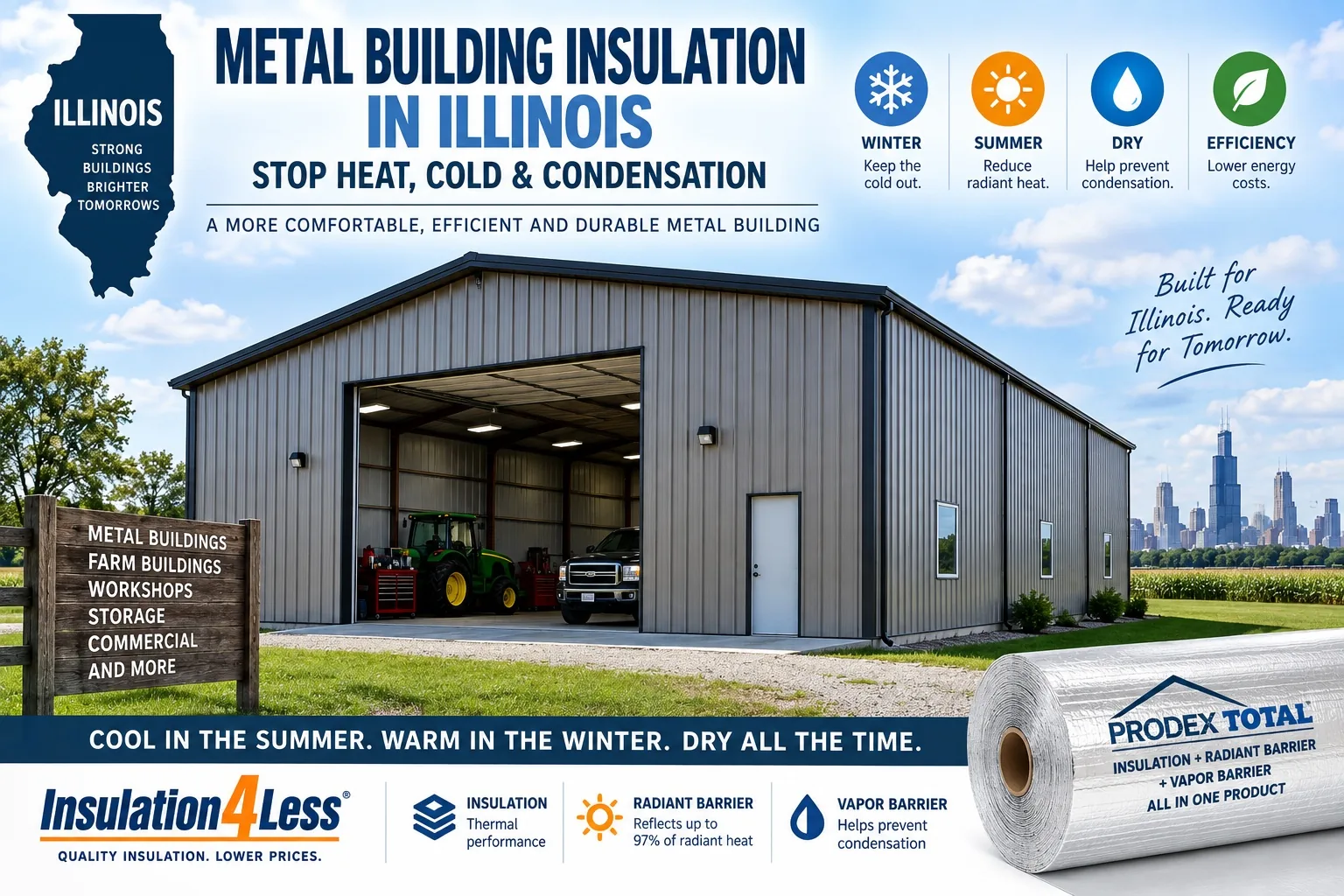
Metal Building Insulation in Illinois: Stop Heat, Cold & Condensation
Insulating a metal building in Illinois presents a different challenge from insulating many conventional wood-framed structures.
Steel transfers heat rapidly. During an Illinois winter, metal roofing and siding can become extremely cold. During summer, those same exterior surfaces can absorb solar energy and become significant sources of heat inside the building.
Then there is condensation. When warm, moisture-containing interior air encounters sufficiently cold steel, water can form on the underside of the roof or wall panels. That makes moisture control an important part of choosing metal building insulation in Illinois.
The goal should not simply be to put insulation between the building and the weather. A well-designed insulation system should address heat, cold and condensation together.
Prodex Total is particularly suited to this challenge because it combines a closed-cell polyethylene foam center with reinforced reflective surfaces.
Prodex Total = Insulation + Radiant Barrier + Vapor Barrier — All in One Product.
Why Illinois Metal Buildings Need the Right Insulation
Illinois experiences substantial seasonal temperature changes, so a metal building can face very different insulation demands throughout the year.
Winter Cold
During cold weather, heat inside a conditioned building moves toward colder exterior surfaces. Because steel conducts heat efficiently, uninsulated metal roofing, siding and framing can contribute to rapid heat transfer. This can make workshops, commercial buildings, agricultural structures and other heated metal buildings expensive and uncomfortable to use during winter.
Summer Radiant Heat
Summer creates the opposite problem. Sunlight striking a metal roof can heat the exterior surface substantially. The hot roof then radiates energy toward the interior. This is one reason the best insulation system for a steel building should not be evaluated solely by conventional R-value. A reflective insulation system can address radiant heat when installed adjacent to an appropriate air space.
Condensation
Condensation can be one of the most overlooked problems in metal buildings. When moisture-containing air reaches a cold metal surface and falls below its dew point, liquid water forms. That water may appear as droplets on the underside of the roof or walls and, under some conditions, can drip into the building.
Over time, uncontrolled condensation can contribute to:
- Wet insulation
- Corrosion
- Mold and mildew
- Water dripping onto equipment or stored materials
- Staining
- Reduced insulation performance
- An uncomfortable interior environment
For a broader discussion of these challenges, see our national guide to insulation for metal buildings.
Metal Buildings Transfer Heat Three Ways
Choosing insulation becomes easier when you understand how heat moves through a steel building.
Conduction
Conduction is heat transfer through solid materials. Steel is an effective conductor, which is why metal roofs, siding and framing can transfer heat relatively quickly. Traditional insulation materials such as fiberglass primarily reduce conductive heat transfer by trapping air within the insulation.
Convection
Convection transfers heat through the movement of air. Gaps and uncontrolled air movement can allow heated or cooled air to escape and outside air to enter. Reducing uncontrolled airflow can therefore be an important part of improving building comfort and efficiency.
Radiation
Radiation transfers heat as electromagnetic energy. This is especially important beneath a metal roof exposed to sunlight. Reflective insulation is designed to reduce radiant heat transfer when the reflective surface faces an adjacent air space. Prodex Total reflects up to 97% of radiant heat. For a deeper explanation of radiant heat and reflective insulation, see the Reflective Insulation Guide.
What Is the Best Metal Building Insulation for Illinois?
There is no single insulation product that is automatically best for every Illinois building.
The appropriate system depends on factors such as:
- Whether the building is heated or cooled
- Building dimensions
- Roof and wall construction
- Interior humidity
- Intended use
- Existing insulation
- Required thermal performance
- Available installation space
- Local building requirements
- Whether condensation is a concern
However, metal buildings create a particularly strong case for insulation that addresses more than conductive heat transfer.
Prodex Total is designed to provide several functions within one system:
- Thermal insulation
- Radiant heat reflection
- Vapor barrier
- Air barrier
- Condensation control
- Moisture resistance
- Mold and mildew resistance
- Sound dampening
For many Illinois steel structures, this combination provides an important advantage over an insulation material designed primarily to slow conductive heat transfer.
Prodex Total for Illinois Metal Buildings
Prodex Total consists of reinforced reflective surfaces with a closed-cell polyethylene foam center. The reflective surfaces help control radiant heat, while the foam center provides a thermal break and does not absorb moisture. Depending on the product and installation, Prodex Total can also function as a vapor and air barrier. This makes it particularly useful in metal structures where condensation and radiant heat can be major concerns.
Summer Performance
When installed with an appropriate adjacent air space, the reflective surface reduces radiant heat transfer from the hot metal roof toward the building interior. This can make garages, workshops, agricultural buildings and other metal structures more comfortable during hot weather.
Winter Performance
During cold weather, the closed-cell foam layer provides thermal resistance and helps reduce heat transfer. A continuous installation can also reduce direct thermal transfer through parts of the building assembly.
Moisture and Condensation Performance
Because Prodex Total uses closed-cell polyethylene foam, it does not absorb water like fibrous insulation can. When properly installed and sealed, it can provide vapor-control and condensation-protection functions particularly valuable in steel structures.
Cool in the Summer. Warm in the Winter. Dry all the Time.
Why Condensation Forms in Illinois Steel Buildings
Condensation is not caused simply by the presence or absence of insulation. It is the result of temperature and moisture conditions. Suppose an Illinois metal workshop is heated during winter. The interior air is warmer than the outside air and contains water vapor. The metal roof may be extremely cold because it is exposed directly to outdoor temperatures. If warm interior air reaches that cold steel and the surface temperature is below the air's dew point, moisture condenses into liquid water.
The same basic process can occur in:
- Metal barns
- Pole buildings
- Agricultural buildings
- Equipment storage buildings
- Warehouses
- Workshops
- Metal garages
- Aircraft hangars
- Commercial steel buildings
The insulation strategy should therefore help keep moisture-containing air from reaching cold metal surfaces while also controlling heat transfer. Prodex Total's combination of thermal resistance and vapor control makes it useful for this purpose when installed correctly.
Insulating New Illinois Metal Buildings
New construction provides an opportunity to incorporate the insulation into the building envelope before the exterior metal panels are completely installed. Prodex Total can be installed across framing members so the insulation forms a relatively continuous layer. This approach can help reduce thermal bridging while providing reflective and vapor-control functions. The exact installation method depends on the building design, framing configuration and Prodex product being used. For reflective performance, an adjacent air space is important. Approximately 3/4 inch to 1 inch or more is generally recommended where applicable.
Review the appropriate Prodex Total installation methods before beginning the project.
Insulating an Existing Illinois Metal Building
Existing metal buildings can also be insulated from the interior.
This is common with:
- Workshops
- Farm buildings
- Garages
- Equipment storage buildings
- Commercial buildings
- Warehouses
- Hobby shops
Retrofit installations require attention to attachment methods, seams, penetrations and the relationship between the insulation and the existing framing. Sealing seams is important because it helps create a more continuous insulation, air and vapor-control layer. The appropriate attachment method depends on the building and framing system. See the how to insulate a metal building for installation options.
Does Reflective Insulation Need an Air Gap?
Yes, an adjacent air space is important for reflective performance. A reflective surface reduces radiant heat transfer most effectively when it faces an air space rather than being sandwiched tightly between solid materials. Approximately 3/4 inch to 1 inch or more of air space is generally recommended where applicable to optimize reflective performance. The exact assembly will depend on whether the insulation is being installed during new construction or retrofitted inside an existing metal building.
Prodex Total vs. Fiberglass in Illinois Metal Buildings
Fiberglass is widely used and can provide effective thermal resistance. It works primarily by trapping air and slowing conductive heat transfer. That makes fiberglass appropriate for many building applications. Metal buildings, however, introduce additional considerations. Fiberglass does not inherently provide an integrated radiant barrier, and moisture management must be addressed separately within the assembly. If condensation wets fiberglass, its thermal performance can be affected until it dries. Persistent moisture can also create additional problems within the building envelope.
Prodex Total does not absorb moisture and combines several functions:
| Consideration | Prodex Total | Fiberglass |
|---|---|---|
| Conductive heat control | Yes | Yes |
| Radiant heat control | Yes, with appropriate air space | Not inherently |
| Vapor control | Can provide vapor-barrier function when properly installed/sealed | Requires appropriate facing/system |
| Moisture absorption | Closed-cell foam does not absorb water | Can retain moisture if exposed |
| Condensation control | Designed to help address condensation in appropriate assemblies | Requires separate condensation/vapor strategy |
| Installation | Flexible rolls | Batts, blankets or rolls depending on product |
This does not mean fiberglass is a bad insulation. In fact, Prodex Total and fiberglass can sometimes be used together. Installing Prodex between the metal sheeting and fiberglass can help protect the fiberglass from condensation and add radiant heat and vapor-control functions to the assembly.
See our fiberglass metal building insulation guide for more information. You can also review Fiberglass vs. Prodex Total for Illinois Buildings for an Illinois-specific comparison.
Prodex Total vs. Spray Foam for Metal Buildings
Spray polyurethane foam can provide insulation and air sealing when professionally installed. However, there are important differences between spray foam and Prodex Total. Spray foam typically requires specialized equipment and careful installation. Installed costs can also be substantially higher because professional labor is generally involved.
Prodex Total is a flexible roll insulation that can be installed without spray equipment or curing time, making it suitable for many do-it-yourself and contractor installations. Prodex also provides a reflective surface for radiant heat control, an important consideration under sun-exposed metal roofing.
The best choice depends on the building, budget, required performance and installation method.
Metal Barn Insulation in Illinois
Illinois agricultural buildings often use metal roofing and siding, making many of the same principles applicable to barns and farm structures. The insulation requirements depend heavily on use. An equipment storage barn may have very different needs from a heated workshop or a building housing animals. Moisture generation can also vary significantly. Where interior humidity is high, condensation control becomes particularly important.
For post-frame structures, see our Illinois pole barn insulation guide and the national insulation for pole barns resource.
Metal Garage & Workshop Insulation
Metal garages and workshops are another common Illinois application. A workshop that is used throughout the year may need protection from both summer radiant heat and winter heat loss. Garages can also experience changing moisture conditions as vehicles, snow and wet equipment are brought inside.
Our Illinois metal garage insulation guide looks specifically at detached garages, workshops, hobby shops and similar buildings. For additional information, see the national metal garage insulation guide.
Don't Forget the Roof
The roof can represent a substantial portion of the exposed surface of a metal building. During summer, it may also receive hours of direct solar exposure. That makes roof insulation important for controlling radiant heat. During winter, the roof becomes one of the cold surfaces where interior moisture can potentially condense. The Illinois roof insulation guide explains roof insulation considerations in greater detail. You can also review the national roof insulation guide for information about insulation types, applications and roof insulation costs.
Consider the Concrete Slab
For a heated Illinois metal building, insulation beneath the concrete floor may also deserve consideration. A slab is in direct contact with the ground and can become another pathway for heat transfer.
Under-slab insulation can be particularly relevant for:
- Heated workshops
- Metal garages
- Commercial buildings
- Agricultural shops
- Radiant heated floors
See Under-Slab Insulation in Illinois for the Illinois application and our national under-slab insulation guide for additional information.
How Much Metal Building Insulation Do I Need?
The amount of insulation required depends on the dimensions of the building, wall height, roof configuration and roof slope.
Use the Insulation4Less Advanced Insulation Calculator to estimate material quantities. Enter the building dimensions and select the roof slope to calculate the approximate amount of insulation needed. This is particularly helpful for large metal buildings because even a modest change in dimensions can significantly affect the total square footage.
Choosing Insulation for Your Illinois Metal Building
Before purchasing insulation, consider the entire building rather than one performance number.
Ask:
Will the Building Be Heated?
If so, winter heat loss and condensation potential become particularly important.
Will It Be Air Conditioned?
Summer heat gain, air movement and vapor control may become more important.
Is the Building Used Year-Round?
A workshop or commercial building used throughout the year may justify a more comprehensive insulation system than an unconditioned storage building.
Does the Building Generate Moisture?
Animals, equipment, vehicles and some commercial processes can increase interior moisture.
Is Radiant Heat a Major Concern?
Metal roofs exposed to direct sunlight can become significant radiant heat sources.
Is the Building New or Existing?
New construction and retrofit applications often require different installation approaches.
What Does the Building Code Require?
Local requirements vary according to building use, construction and jurisdiction. Prodex Total should not be assumed to satisfy every code requirement or every building assembly automatically. Consult applicable building requirements or a qualified professional when necessary.
Why Prodex Total Works Well in Illinois Metal Buildings
Illinois metal buildings face several insulation challenges simultaneously. Winter creates cold exterior steel surfaces and heating demands. Summer creates solar and radiant heat. Temperature differences can contribute to condensation. A useful insulation system should therefore address more than one mechanism of heat transfer and moisture movement.
Prodex Total combines:
Insulation + Radiant Barrier + Vapor Barrier in one flexible product.
That combination is why it is particularly well suited to many steel buildings, metal barns, workshops, garages and agricultural structures. For additional information about selecting and installing steel building insulation, review our complete national metal-building guide.
Frequently Asked Questions About Illinois Metal Building Insulation
What is the best insulation for a metal building in Illinois?
The best insulation depends on building use, construction, heating and cooling requirements, moisture conditions and applicable codes. For many metal buildings, Prodex Total offers an advantage because it addresses conductive heat, radiant heat, vapor movement and condensation within one insulation system.
How do you stop condensation in an Illinois metal building?
Condensation control requires managing both temperature and moisture. Warm, moisture-containing air should be prevented from reaching cold steel surfaces where possible. A properly installed and sealed Prodex Total system can provide thermal resistance and vapor control that help prevent condensation.
Is fiberglass good insulation for a metal building?
Fiberglass can provide effective resistance to conductive heat transfer and is commonly used in metal buildings. However, the assembly must also address vapor movement and condensation. Prodex Total can be used independently in appropriate applications or can complement fiberglass by adding radiant heat and vapor-control functions.
Can I install Prodex Total in an existing metal building?
Yes. Prodex Total can be installed in many existing metal buildings from the interior. The appropriate installation method depends on the framing system, building design and desired insulation assembly.
Can Prodex Total be installed in a new metal building?
Yes. New construction provides several installation options because the insulation can be incorporated as roofing and siding are installed. Review the applicable installation method before beginning construction.
Does Prodex Total require an air space?
An adjacent air space is important for reflective performance. Approximately 3/4 inch to 1 inch or more is generally recommended where applicable to optimize radiant heat performance.
Does Prodex Total absorb moisture?
The closed-cell polyethylene foam center does not absorb water. This is particularly useful in metal buildings where condensation and moisture can be concerns.
Does Prodex Total help with summer heat?
Yes. Prodex Total reflects up to 97% of radiant heat. When properly installed adjacent to an air space, its reflective surface can significantly reduce radiant heat transfer from hot metal roofing toward the building interior.
How much insulation do I need for my metal building?
Use the Advanced Insulation Calculator. Enter the building dimensions and roof slope to estimate the amount of insulation required.
Related Illinois Insulation Guides
Continue researching your project with these Illinois-specific insulation resources:
- Illinois Insulation Guide — Start here for insulation options across Illinois building types.
- Pole Barn Insulation in Illinois — Insulation for post-frame barns, agricultural buildings and workshops.
- Metal Garage Insulation in Illinois — Control heat, cold and condensation in metal garages and workshops.
- Roof Insulation in Illinois — Roof insulation, radiant heat, moisture and cost considerations.
- Shipping Container Insulation in Illinois — Insulating steel containers against temperature extremes and condensation.
- Quonset Hut Insulation in Illinois — Insulation for curved steel buildings.
- Under-Slab Insulation in Illinois — Under-concrete insulation for heated slabs, shops and metal buildings.
- House Insulation in Illinois — Residential insulation for Illinois heating, cooling and moisture conditions.
- Fiberglass vs. Prodex Total for Illinois Buildings — Compare insulation approaches for Illinois applications.
Insulate Your Illinois Metal Building for Every Season
A metal building in Illinois does not face just one insulation problem. It can face winter heat loss, summer radiant heat, moisture, air movement and condensation—all within the same year. That is why selecting insulation based solely on R-value can overlook important aspects of steel-building performance. Prodex Total addresses multiple forms of heat transfer while providing vapor and condensation protection in one system.
Cool in the Summer. Warm in the Winter. Dry all the Time.
One Solution to Heat, Cold and Condensation – Prodex Total.