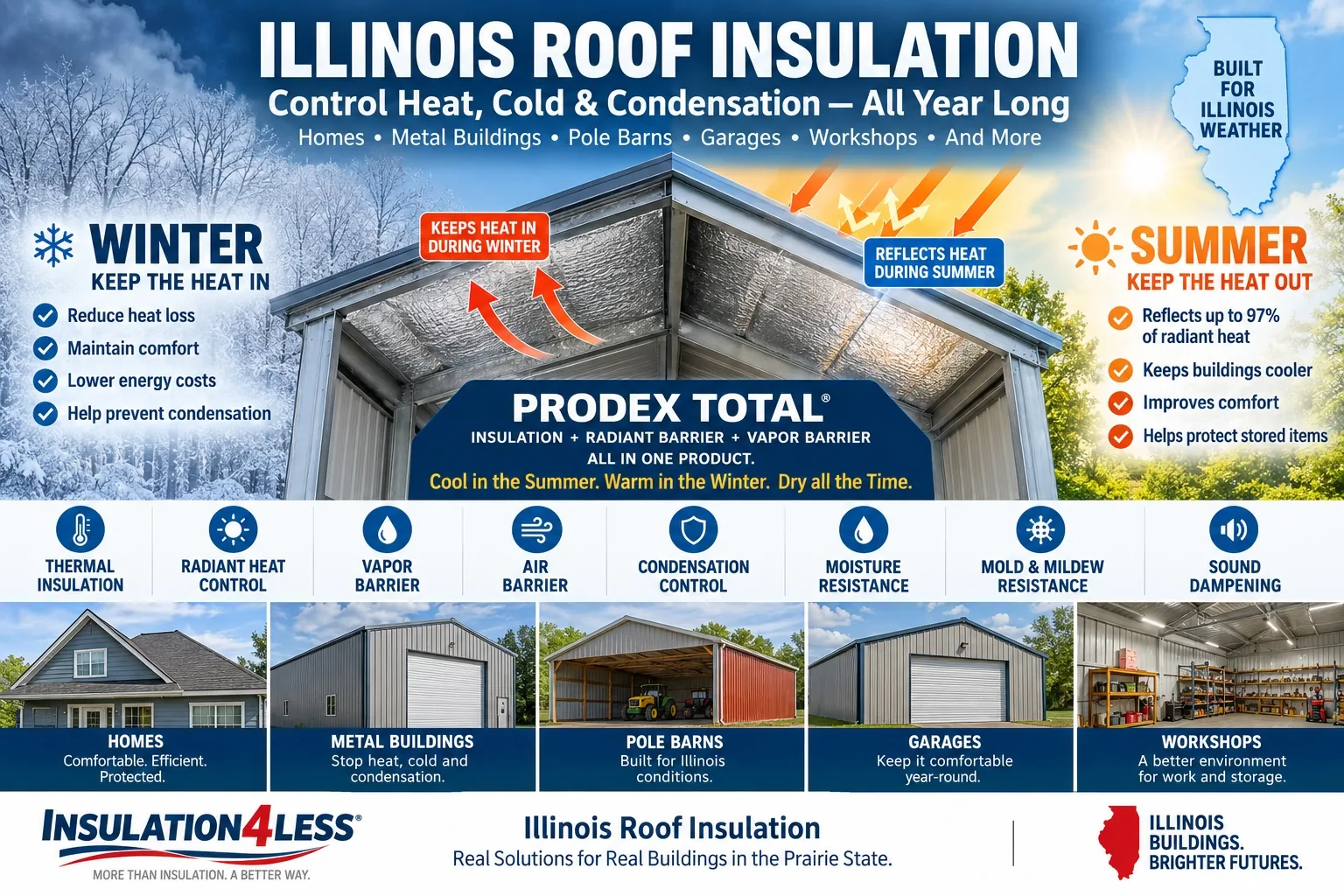
Roof & Ceiling Insulation in Illinois: Control Heat, Cold & Condensation
Illinois roofs face two very different seasons. During winter, the roof and ceiling separate heated interiors from freezing outdoor conditions. During summer, hours of direct sunlight can turn roofing into a major source of heat entering the building.
Metal roofs introduce another challenge: condensation. When warm, moisture-containing interior air reaches sufficiently cold metal, water can form on the underside of the roof.
That's why choosing the best roof insulation in Illinois involves more than looking at R-value. A good roof insulation strategy should consider winter heat loss, summer heat gain, radiant heat, air movement, vapor movement, moisture and condensation.
For a complete national comparison of materials, applications and costs, see our Roof Insulation Guide.
Prodex Total = Insulation + Radiant Barrier + Vapor Barrier — All in One Product.
Cool in the Summer. Warm in the Winter. Dry all the Time.
Why Roof Insulation Matters in Illinois
The roof represents a substantial part of a building envelope. When it is poorly insulated, unwanted heat can move through the assembly in either direction. During an Illinois winter, heat from a conditioned building moves toward the colder exterior. During summer, solar energy heats the roof and can increase temperatures beneath it. The appropriate solution depends on the building. A house with an attic may need a different insulation strategy than a metal building with exposed purlins. A heated pole barn may have different moisture concerns than an unconditioned agricultural building. A workshop used every day requires a different level of comfort than a garage used primarily for storage.
For an overview covering different Illinois building types, start with our Illinois Insulation Guide.
Illinois Roof Insulation for Winter Cold
Winter makes thermal performance particularly important. When the interior of a building is heated, the temperature difference between indoors and outdoors drives heat toward the colder exterior. Insulation helps slow that transfer. Air leakage matters too. Gaps in a roof or ceiling assembly can allow conditioned air to escape even when substantial insulation is present. For that reason, effective roof insulation should be considered as part of an overall building-envelope system rather than simply a layer of material between framing members.
Illinois Roof Insulation for Summer Heat
Roof insulation is just as important during summer. Sunlight heats roofing throughout the day. A hot roof can then transfer energy toward the cooler interior. This is especially noticeable in steel buildings, pole barns, metal garages and workshops. Traditional insulation primarily addresses conductive heat transfer. Reflective insulation can also reduce radiant heat transfer when a reflective surface faces an appropriate air space. Prodex Total reflects up to 97% of radiant heat. With the appropriate adjacent air space, its reflective surfaces help reduce radiant energy moving from a hot roof toward the building interior. The Illinois Metal Building and Pole Barn guides likewise emphasize the importance of an adjacent air space for reflective performance.
Condensation Under Illinois Metal Roofs
Condensation can be one of the most damaging problems associated with an improperly insulated metal roof. Metal responds quickly to outdoor temperature changes. During cold weather, the underside of the roof can become cold enough for moisture in warmer interior air to condense on it. The result may be dripping water, wet stored materials, corrosion, mold or deterioration of moisture-sensitive components. Simply adding insulation does not automatically solve every condensation problem. A successful assembly also needs to consider air leakage and vapor movement. This is one reason Prodex Total is particularly useful beneath metal roofing. It combines closed-cell insulation with reflective surfaces and air/vapor-control functions.
For an entire steel structure rather than just its roof, see Illinois Metal Building Insulation.
What Is the Best Roof Insulation for Illinois?
There is no single insulation material that is best for every Illinois roof.
The right choice depends on:
- Building construction
- Roof material
- Climate exposure
- Whether the building is heated or cooled
- Required thermal performance
- Moisture and condensation conditions
- New construction versus retrofit
- Installation cost
- Applicable building and energy requirements
The major options include fiberglass, spray foam, rigid foam and reflective insulation.
Fiberglass Roof and Ceiling Insulation
Fiberglass is one of the most widely used conventional insulation materials. It provides effective resistance to conductive heat flow and is commonly installed in residential ceilings and attics as well as commercial and metal-building systems. Its limitation in a metal-roof application is that thermal resistance isn't the only issue. The roof assembly may also need to address radiant heat, air movement and condensation. Fiberglass can be combined with Prodex Total in appropriate assemblies, allowing fiberglass to provide additional thermal resistance while Prodex contributes radiant and vapor-control functions.
Learn more in our Fiberglass Metal Building Insulation Guide.
Spray Foam Roof Insulation
Spray polyurethane foam can provide thermal insulation and air sealing. It may be useful in certain residential and commercial roof assemblies, particularly where irregular surfaces or penetrations make other materials difficult to install. However, spray foam generally involves specialized application, equipment and installation considerations. Cost should therefore be evaluated on an installed-system basis rather than by comparing insulation material alone.
Rigid Foam Board Roof Insulation
Rigid foam board provides thermal resistance in a relatively thin material and can work well in certain roof assemblies. However, panels must be cut and fitted around framing and penetrations. Seams and transitions must also be properly detailed where air or vapor control is required.
For a detailed discussion of its advantages and limitations, see our Foam Board Insulation Guide.
Prodex Total Roof Insulation
Prodex Total combines reinforced reflective surfaces with a closed-cell polyethylene foam center.
For appropriate roof assemblies, Prodex Total can provide:
- Thermal insulation
- Radiant heat control
- Vapor barrier
- Air barrier
- Condensation control
- Moisture resistance
- Mold and mildew resistance
- Sound dampening
The closed-cell polyethylene foam center does not absorb water, an important advantage in applications where condensation and moisture are concerns.
Illinois Metal Roof Insulation
Metal roofs present a special insulation challenge because metal transfers heat efficiently. During summer, solar radiation can rapidly heat the roofing. During winter, cold exterior temperatures can create very cold interior metal surfaces. An effective metal roof insulation system therefore needs to consider thermal transfer, radiant heat and condensation. Prodex Total is particularly suited to these applications because the same insulation system can provide thermal insulation, radiant heat control and vapor-barrier performance. If you're insulating an entire steel structure rather than simply the roof, see our complete Illinois Metal Building Insulation Guide.
For broader information about insulation for metal buildings, including roofs, walls and condensation control, use our national guide.
Pole Barn Roof Insulation in Illinois
Large metal roofs are common on Illinois pole barns and post-frame buildings. These buildings may house equipment, vehicles, livestock, agricultural materials or workshops, making both temperature control and moisture management important. During summer, the large roof area can absorb substantial solar energy. During winter, an uninsulated steel roof can become an ideal condensation surface when warm interior air contains moisture. Prodex Total can address both concerns by reducing radiant heat transfer and providing insulation and vapor control.
For the complete application-specific discussion, visit Illinois Pole Barn Insulation or the national Pole Barn Insulation Guide.
Metal Garage and Workshop Roof Insulation
Illinois garages and workshops can be uncomfortable at both temperature extremes. A metal garage roof exposed to summer sun can radiate substantial heat into the space below. In winter, heating a previously cold garage creates a large temperature difference between the warm interior and cold exterior metal. That makes condensation control particularly important in heated workshops and garages. Insulating the roof can improve comfort, reduce unwanted heat transfer and help protect tools, vehicles and equipment from moisture.
See Illinois Metal Garage Insulation for the complete application guide.
For garages outside Illinois, our national Metal Garage & Workshop Insulation Guide covers the application in greater detail.
House Roof and Ceiling Insulation in Illinois
Homes present a different situation from open-framed metal buildings. Depending on the design, insulation may be installed at the attic floor or ceiling level, along the roofline, or as part of another roof assembly. Fiberglass, blown insulation, rigid foam, spray foam and reflective products may all have appropriate residential applications. The important point is to determine where the building's thermal and air-control boundaries are intended to bebefore selecting the insulation system.
For whole-house considerations involving roofs, ceilings, walls and other areas, see our House Insulation Guide.
How Much Does Roof Insulation Cost in Illinois?
There is no single accurate cost for every Illinois roof-insulation project.
Roof insulation costs depend on:
- Type of insulation
- Required amount of material
- Roof size and slope
- Required thermal performance
- New construction versus retrofit
- Accessibility
- Existing insulation
- Labor
- Installation complexity
- Whether separate air or vapor-control materials are required
This is why comparing only the advertised material price can be misleading. A better comparison is the total installed system. The national Roof Insulation Guide provides a broader discussion of roof insulation costs and the factors affecting pricing.
How Much Roof Insulation Do I Need?
Roof area is not always the same as floor area. Roof pitch increases the actual surface area that must be covered.
When estimating an Illinois project, consider:
- Building length
- Building width
- Wall height when walls are included
- Roof slope
- Roof configuration
- Installation method
Use our Advanced Insulation Calculator to estimate the amount of insulation required. Enter the building dimensions using numerals and select the roof slope. The calculator will estimate the required insulation quantity. The Illinois hub and existing Illinois application pages also direct customers to this calculator for quantity estimates.
New Construction Roof Insulation
New construction generally provides the most installation flexibility because the insulation can be incorporated into the assembly before the exterior roofing is installed. For metal buildings, Prodex Total is typically installed perpendicular to the framing while maintaining the appropriate sag or air space for reflective performance. With 10M Prodex Total Plus, the heat-weldable seams can be joined without separate seam tape. The exact installation method depends on the building and framing system.
Before beginning, review our How to Insulate a Roof installation guide.
Insulating an Existing Illinois Roof
Existing metal buildings, pole barns, garages and workshops can often be insulated from the interior. The installation method depends on the framing configuration, roof construction and whether existing insulation or interior finishes are present. Prodex Total can be installed across the framing from the interior while maintaining an appropriate air space where required for reflective performance. For step-by-step methods covering both new construction and existing buildings, see How to Insulate a Roof.
Does Reflective Roof Insulation Need an Air Gap?
Yes, an adjacent air space is important for radiant-barrier performance. A reflective surface reduces radiant heat transfer when it faces an air space. If the reflective surface is sandwiched tightly between solid materials, it cannot provide the same radiant-barrier benefit. Approximately 3/4 inch to 1 inch or more is generally recommended where applicable to optimize reflective performance. This is also the guidance used on the existing Illinois Metal Building and Pole Barn pages.
Can Prodex Total Be Used With Fiberglass?
Yes. The two products perform different functions and can complement each other in an appropriately designed assembly. Fiberglass provides conductive thermal resistance. Prodex Total can add radiant heat control, vapor control and a thermal break while helping protect fiberglass from condensation and moisture in certain metal-building assemblies. This can be particularly useful when a project requires more total thermal resistance than Prodex alone provides.
For a detailed comparison, see Prodex Total vs. Fiberglass for Metal Buildings.
Illinois Roof Insulation and Building Codes
Insulation requirements vary according to the building, construction type, location and applicable code. A particular Prodex Total R-value—or the R-value of any other insulation product—should not be interpreted as guaranteeing that a specific Illinois roof assembly meets local requirements. Before purchasing or installing insulation where code compliance is required, verify the complete assembly with the appropriate local building official, contractor, architect or other qualified professional.
Recommended Roof Insulation: 10M Prodex Total Plus
For many appropriate Illinois roof applications, our primary recommendation is 10M Prodex Total Insulation Plus.
10M Plus combines:
Reflective insulation + radiant barrier + vapor barrier + air barrier + condensation control.
The product is approximately 10 mm (0.4 inch) thick, and each 4-foot × 85.3-foot roll covers approximately 341 square feet.
It is particularly useful for:
- Metal buildings
- Pole barns
- Metal garages
- Workshops
- Warehouses
- Agricultural buildings
- Metal-roof applications
The national Roof Insulation Guide likewise identifies 10M Prodex Total Plus as the premium recommendation for many roof applications.
Frequently Asked Questions About Illinois Roof Insulation
What is the best roof insulation for Illinois?
The best roof insulation depends on the building and roof construction. Homes, metal buildings, pole barns and garages can require different assemblies. For metal roofs where radiant heat and condensation are major concerns, Prodex Total provides thermal insulation, reflective insulation and vapor control in one product.
What is the best insulation for an Illinois metal roof?
An effective metal-roof system should address conductive heat transfer, radiant heat, air movement and condensation. Prodex Total is particularly suited to metal roofs because it combines insulation with radiant-barrier and vapor-barrier functions. See our Illinois Metal Building Insulation Guide for complete steel-building information.
Does roof insulation help keep an Illinois building cooler in summer?
Yes. Thermal insulation slows heat transfer, while reflective insulation can additionally reduce radiant heat transfer from a hot roof when installed facing an appropriate air space.
Will roof insulation stop condensation?
The correct insulation assembly can help prevent condensation, but condensation depends on temperature, humidity, air leakage and vapor movement. Metal roofs require particular attention because the steel surface can cool rapidly.
Can Prodex Total be installed in an existing building?
Yes. Many existing metal buildings, pole barns and garages can be insulated from the interior. See How to Insulate a Roof for installation options.
Does Prodex Total require an air space?
An adjacent air space is important for reflective performance. Approximately 3/4 inch to 1 inch or more is generally recommended where applicable.
Can Prodex Total be installed with fiberglass?
Yes. In appropriate assemblies, fiberglass can provide additional conductive thermal resistance while Prodex adds radiant and vapor-control functions.
How much roof insulation do I need?
Use the Advanced Insulation Calculator. Enter the building dimensions and select the roof slope to estimate the amount of insulation required.
How much does roof insulation cost in Illinois?
Cost depends on material, roof area, required performance, installation method and labor. Compare the complete installed system rather than only material cost. Our national Roof Insulation Guide provides additional information about roof insulation costs.
Related Illinois Insulation Guides
Illinois Insulation Guide — Complete overview of insulation for Illinois homes and buildings.
Illinois Metal Building Insulation — Insulation for Illinois steel buildings with an emphasis on heat, cold and condensation.
Illinois Pole Barn Insulation — Insulation for Illinois pole barns and post-frame buildings.
Illinois Metal Garage Insulation — Insulation for garages and workshops exposed to Illinois seasonal conditions.
Illinois Shipping Container Insulation
Illinois Quonset Hut Insulation
Illinois Under-Slab Insulation
Fiberglass vs. Prodex Total for Illinois Buildings
Insulate the Roof — Protect the Building
Whether you're insulating an Illinois home, metal building, pole barn, garage, workshop or agricultural building, the roof deserves special attention. It receives direct solar radiation during summer. It separates interior heat from winter cold. And with metal roofing, it can become a significant condensation surface. That's why the best roof insulation should be selected as part of a complete system rather than on R-value alone.
For national roof-insulation information, product comparisons and cost considerations, continue to our Roof Insulation Guide.
Prodex Total = Insulation + Radiant Barrier + Vapor Barrier — All in One Product.
Cool in the Summer. Warm in the Winter. Dry all the Time.
One Solution to Heat, Cold and Condensation – Prodex Total.