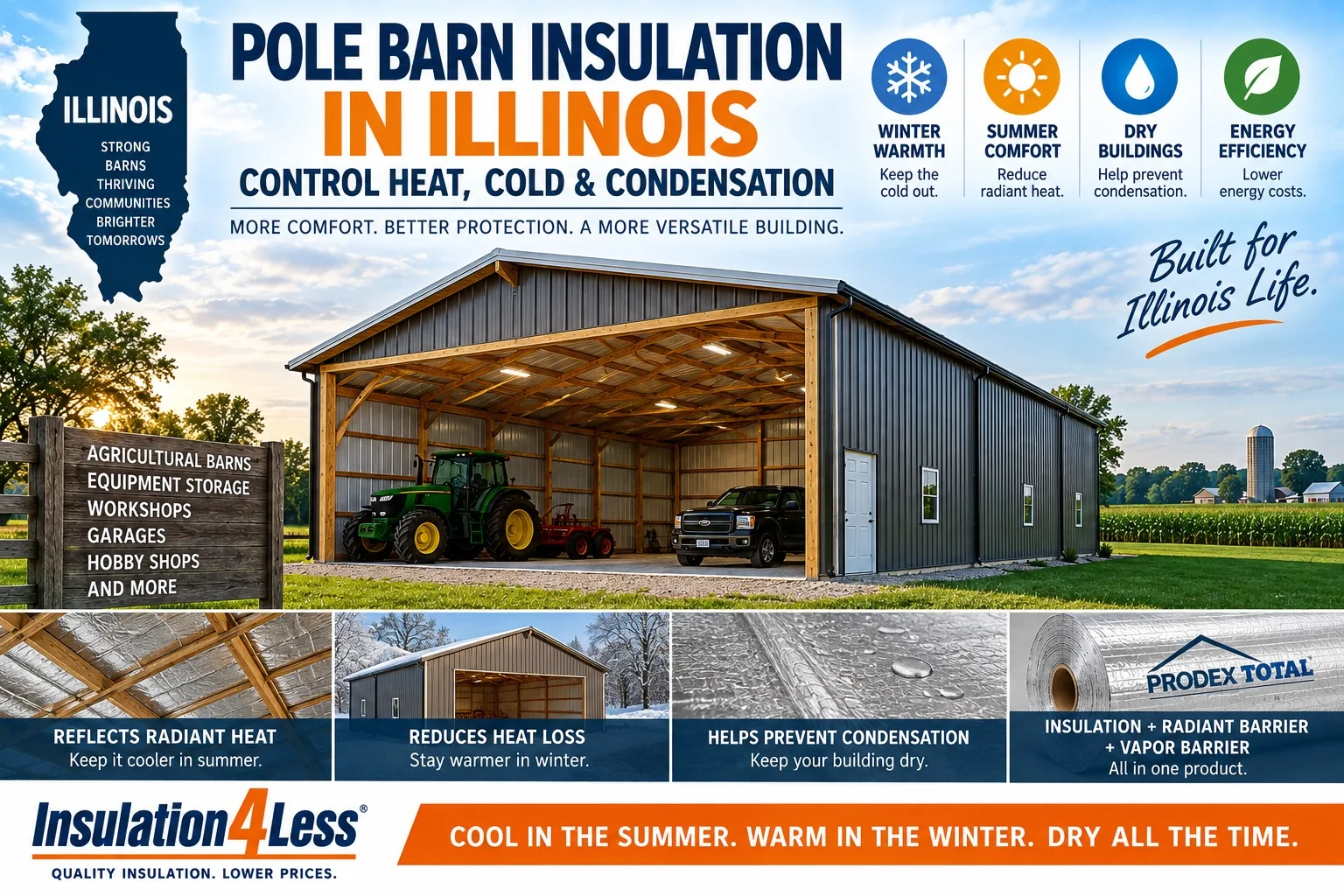
Pole Barn Insulation in Illinois: Control Heat, Cold & Condensation
Pole barns are popular throughout Illinois for agriculture, equipment storage, workshops, garages, commercial uses and general storage.
Their post-frame construction makes them economical and versatile, but the metal roofing and siding commonly used on pole buildings create particular insulation challenges.
During winter, exterior metal can become extremely cold. During summer, a sun-exposed metal roof can become a major source of radiant heat. And when warm, moisture-containing air encounters cold steel, condensation can develop.
That means choosing pole barn insulation in Illinois should involve more than looking at R-value.
A successful insulation system should address the building as a whole—heat, cold, radiant energy, air, moisture and condensation.
Prodex Total is particularly useful for these conditions because it combines reinforced reflective surfaces with a closed-cell polyethylene foam center.
Prodex Total = Insulation + Radiant Barrier + Vapor Barrier — All in One Product.
Why Insulate an Illinois Pole Barn?
The answer depends partly on how the building is used.
An unconditioned machine shed has different requirements from a heated workshop. A livestock building generates different amounts of moisture from an equipment storage building.
However, insulation can improve many Illinois pole buildings by helping control:
- Winter heat loss
- Summer radiant heat
- Roof and wall condensation
- Interior temperature swings
- Vapor movement
- Air movement
- Moisture
- Interior comfort
Insulation becomes particularly important if the pole barn will be heated, cooled or occupied regularly.
For a broader national resource, see our complete guide to pole barn insulation.
Illinois Weather Creates a Year-Round Insulation Challenge
Pole barn insulation is sometimes approached primarily as winter protection. In Illinois, that overlooks half of the problem.
Cold Illinois Winters
During winter, heat moves from the warmer interior of a conditioned pole barn toward colder exterior surfaces. Metal roofing and siding conduct heat efficiently. Without an effective thermal barrier, a heated workshop or agricultural building can lose heat rapidly. Cold steel also creates conditions where condensation may form.
Hot Illinois Summers
Summer creates the opposite heat-flow problem. A metal roof exposed to direct sunlight absorbs solar energy and can become substantially hotter than the surrounding air. That heated roof then radiates energy toward the interior. Reflective insulation can reduce this radiant heat transfer when installed adjacent to an appropriate air space.
Humidity and Moisture
Pole barns can contain moisture from numerous sources, including:
- Humid outside air
- Vehicles
- Wet equipment
- Animals
- Stored agricultural materials
- Ground moisture
- Human activity
When that moisture combines with cold metal surfaces, condensation becomes possible.
Why Does a Pole Barn Roof Sweat?
What is often called a sweating pole barn roof is usually condensation. The metal itself is not producing water. Instead, water vapor in the air is changing into liquid water when it encounters a sufficiently cold surface. Consider a heated Illinois workshop on a cold winter day. The interior air contains moisture. The steel roof is exposed to cold outdoor temperatures. If warm interior air reaches the underside of that cold roof and the metal temperature is below the air's dew point, moisture forms on the steel.
You may then see:
- Water droplets beneath the roof
- Moisture on metal siding
- Dripping from the ceiling
- Wet framing or insulation
- Damp stored materials
- Rust or corrosion over time
The insulation system therefore needs to help manage both temperature and moisture.
How Prodex Total Helps Control Pole Barn Condensation
Prodex Total can help prevent condensation when it is properly incorporated into the building assembly. Its closed-cell polyethylene foam center provides a thermal break, while properly sealed reflective surfaces can provide vapor-control and air-barrier functions. Unlike fibrous insulation, the closed-cell foam does not absorb water. This combination can help keep moisture-containing interior air from contacting cold metal surfaces while also reducing heat transfer. That makes condensation control one of the strongest reasons to consider Prodex Total for an Illinois pole building.
One Solution to Heat, Cold and Condensation – Prodex Total.
How Heat Moves Through a Pole Building
Understanding heat transfer explains why different insulation products behave differently.
Conduction
Conduction is heat moving through solid materials. Steel roofing, siding and framing can conduct heat efficiently. Fiberglass and other conventional insulation products primarily work by slowing conductive heat transfer.
Convection
Convection transfers heat through moving air. Gaps and uncontrolled air movement can allow conditioned air to escape and outdoor air to enter. A more continuous and properly sealed insulation layer can help control unwanted airflow.
Radiation
Radiant heat travels as electromagnetic energy. This becomes especially important underneath an Illinois metal roof during summer. Prodex Total's reflective surfaces are designed to reduce radiant heat transfer when facing an adjacent air space. Prodex Total reflects up to 97% of radiant heat. Learn more about this heat-transfer mechanism in our Reflective Insulation Guide.
What Is the Best Insulation for an Illinois Pole Barn?
There is no single insulation product appropriate for every pole barn.
The best choice depends on:
- Building use
- Whether it is heated
- Whether it is air conditioned
- Interior humidity
- Roof and wall construction
- Required thermal performance
- Condensation potential
- Available installation space
- Budget
- Local building requirements
For many metal-sided post-frame buildings, however, an insulation system that addresses radiant heat and condensation in addition to conductive heat can offer significant advantages.
Prodex Total can provide:
- Thermal insulation
- Radiant heat reflection
- Vapor barrier
- Air barrier
- Condensation control
- Moisture resistance
- Mold and mildew resistance
- Sound dampening
This combination makes it especially useful for many Illinois pole barns and agricultural buildings.
Prodex Total for Illinois Pole Barns
Prodex Total consists of reinforced reflective surfaces surrounding a closed-cell polyethylene foam center. This construction allows it to address several different building-envelope functions.
Helps Keep Pole Barns Cooler in Summer
A metal pole barn roof can absorb substantial solar energy. With an appropriate adjacent air space, Prodex Total reflects radiant heat away from the building interior rather than allowing as much radiant energy to travel downward.
Helps Keep Heated Pole Barns Warmer in Winter
The closed-cell foam center provides thermal resistance that helps reduce heat transfer through the building envelope. A properly designed continuous installation can also help reduce thermal bridging through parts of the structure.
Helps Keep Pole Barns Dry
Prodex Total does not absorb water. When seams and penetrations are properly sealed, the insulation can provide vapor-control and air-barrier functions that help keep warm, moisture-containing air from reaching cold exterior metal. That combination is particularly important for condensation control.
Cool in the Summer. Warm in the Winter. Dry all the Time.
Insulating a New Pole Barn in Illinois
New construction offers an excellent opportunity to incorporate Prodex Total into the building envelope as the structure is erected. The insulation can be installed across framing members before exterior metal panels are fully secured. This can create a relatively continuous insulation layer and help reduce direct thermal transfer through framing.
Installation details depend on:
- Pole spacing
- Girt and purlin configuration
- Roof construction
- Insulation product
- Building design
For reflective performance, an adjacent air space is important. Approximately 3/4 inch to 1 inch or more is generally recommended where applicable to optimize reflective performance. Review the appropriate how to Insulate a pole barn methods before beginning the project.
Insulating an Existing Illinois Pole Barn
Existing pole barns can often be insulated from the interior.
Retrofit insulation is common when an older storage building is converted into:
- A heated workshop
- Vehicle storage
- A hobby shop
- Equipment repair space
- A commercial workspace
- Conditioned storage
A retrofit requires careful attention to framing, attachment points, seams and penetrations. Sealing seams is particularly important because it helps create a more continuous thermal, air and vapor-control layer. The correct installation method depends on the existing structure. See our insulation installation guides for application-specific methods.
Does Prodex Need an Air Gap in a Pole Barn?
An adjacent air space is important for reflective performance. The reflective surface works by reducing radiant energy across that air space. Approximately 3/4 inch to 1 inch or more of air space is generally recommended where applicable to optimize reflective performance. Installation configuration will differ between new construction and retrofit projects, so review the appropriate installation method for the building.
Pole Barn Roof Insulation
The roof deserves special attention because it is exposed directly to both sunlight and outdoor temperatures. During summer, solar energy can turn the metal roof into a substantial radiant heat source. During winter, the roof may become one of the coldest surfaces in the building and therefore one of the most likely locations for condensation. An effective roof insulation system can help address both problems. Our Illinois roof insulation guide provides more information about roof applications. For nationwide information about materials, installation and costs, see our roof insulation guide.
Pole Barn Wall Insulation
Walls also contribute to heat transfer and condensation. Metal siding conducts heat readily, and exterior wall temperatures can change substantially throughout the year. If a pole barn is conditioned, insulating both the roof and walls can help create a more complete building envelope. Continuous insulation can also help reduce direct heat transfer through framing components. The appropriate wall assembly depends on the building design, interior finish and intended use.
Pole Barn Ceiling Insulation
Some pole barns include a finished ceiling that separates the occupied space from the roof cavity. This creates different insulation options than a completely open building. Depending on the assembly, insulation may be installed at the ceiling level, roof level or as part of a combined system.
The correct choice depends on:
- Whether the attic or roof cavity is vented
- Moisture conditions
- Building use
- Heating and cooling
- Required thermal performance
- Local requirements
Avoid assuming that one pole barn insulation configuration will work for every building.
Prodex Total vs. Fiberglass for Pole Barns
Fiberglass is a proven insulation material that effectively slows conductive heat transfer. It can work well in many building assemblies. However, pole barns with metal roofing and siding present additional concerns involving radiant heat, moisture and condensation. Fiberglass does not inherently provide the same integrated radiant barrier and vapor-control functions as Prodex Total.
| Consideration | Prodex Total | Fiberglass |
|---|---|---|
| Conductive heat control | Yes | Yes |
| Radiant heat control | Yes, with appropriate air space | Not inherently |
| Vapor control | Can provide vapor-barrier function when properly installed and sealed | Requires appropriate facing/system |
| Water absorption | Closed-cell foam does not absorb water | Can retain moisture if exposed |
| Condensation control | Helps address condensation in properly designed assemblies | Requires separate vapor/condensation strategy |
| Installation | Flexible rolls | Batts, blankets or rolls depending on product |
The two products can also complement one another. In some metal-building assemblies, Prodex can be installed between the metal exterior and fiberglass, helping protect the fiberglass from condensation while adding radiant heat and vapor-control functions.
See our fiberglass metal building insulation resource and Fiberglass vs. Prodex Total for Illinois Buildings for additional information.
Pole Barn Insulation vs. Spray Foam
Spray polyurethane foam is another option for post-frame buildings. Properly installed spray foam can provide thermal insulation and air sealing. However, spray foam generally requires specialized equipment and careful application. Professional installation can also make it considerably more expensive than a DIY roll-insulation system. Prodex Total requires no spray equipment or curing time and can be installed by many building owners and contractors using ordinary tools. It also provides a reflective surface specifically designed to address radiant heat. Which system makes sense depends on the building, performance requirements, installation preferences and budget.
Insulating Agricultural Pole Barns
Agricultural buildings require special consideration because building use can significantly affect moisture conditions. A machinery storage building may generate relatively little interior moisture. A livestock building can be entirely different. Animals, water and agricultural activities can add significant moisture to interior air. Ventilation may therefore be critical, and insulation should not be expected to compensate for inadequate moisture management.
For agricultural pole buildings, consider:
- Interior humidity
- Ventilation
- Animal occupancy
- Stored crops or materials
- Heating
- Equipment
- Wash-down or water use
Insulation should be one part of an appropriate overall building system.
Insulating a Pole Barn Workshop
Workshops are among the strongest applications for comprehensive pole barn insulation. If you spend hours inside the building throughout the year, comfort becomes much more important than it is in simple equipment storage.
A heated or cooled workshop may benefit from insulating:
- Roof
- Walls
- Doors
- Concrete slab
Air leakage should also be controlled. If the building has a metal garage door or large overhead doors, those areas can represent substantial parts of the building envelope. For related information, see Metal Garage Insulation in Illinois.
Under-Slab Insulation for Illinois Pole Barns
The building envelope does not necessarily end at the walls. A heated concrete slab can transfer energy toward colder ground.
Under-slab insulation may therefore be worth considering before concrete is poured, particularly for:
- Heated workshops
- Agricultural shops
- Garages
- Commercial pole buildings
- Radiant floor heating
Our Under-Slab Insulation in Illinois guide explains this application. For broader information, see the national under-slab insulation guide.
How Much Pole Barn Insulation Do I Need?
Insulation quantity depends on the dimensions of the pole barn, wall height and roof design. Use the Insulation4Less Advanced Insulation Calculator to estimate the amount required. Enter the building dimensions and select the roof slope to calculate an approximate insulation quantity. This is particularly useful for pole barns because the roof area can differ substantially from the building's floor area depending on roof pitch.
How to Choose Insulation for Your Illinois Pole Barn
Before selecting insulation, consider these questions.
What Will the Pole Barn Be Used For?
Equipment storage, livestock, workshops and commercial spaces can have very different insulation requirements.
Will You Heat the Building?
Heating increases the temperature difference between the interior and exterior during winter and can increase condensation concerns.
Will You Cool the Building?
If air conditioning is planned, summer heat gain, air movement and vapor control become more important.
How Much Moisture Will Be Generated Inside?
Livestock and some agricultural operations can produce substantial moisture.
Is Summer Radiant Heat a Problem?
If the metal roof receives direct sunlight, radiant heat can significantly affect interior comfort.
Is the Building New or Existing?
New construction generally provides more installation options than a retrofit.
Are You Insulating the Slab?
If the building will have a heated floor, under-slab insulation should be considered before concrete is poured.
What Are the Applicable Building Requirements?
Insulation requirements can vary by building type, use and jurisdiction. Consult applicable codes or qualified professionals where appropriate.
Frequently Asked Questions About Illinois Pole Barn Insulation
What is the best insulation for a pole barn in Illinois?
The best insulation depends on the building's use, construction, heating and cooling requirements, moisture conditions and applicable codes. Prodex Total is particularly useful in many pole barns because it addresses thermal transfer, radiant heat, vapor movement and condensation in one system.
How do I stop my pole barn roof from sweating?
A sweating metal roof is generally condensation. Warm, moisture-containing air reaches cold steel and water forms when the surface is below the dew point. Controlling moisture, air movement and surface temperature helps address the problem. Properly installed Prodex Total can provide thermal and vapor-control functions that help prevent condensation.
Should I insulate the roof or ceiling of my pole barn?
It depends on the building design. Open pole barns commonly insulate at the roofline, while buildings with finished ceilings may use a different assembly. Ventilation, moisture, heating and cooling should all be considered.
Is fiberglass good for pole barns?
Fiberglass can provide effective conductive insulation and is widely used. However, metal pole barns also require attention to condensation and vapor control. Fiberglass may need appropriate facing or additional components to address those concerns.
Can Prodex Total be used with fiberglass?
Yes. In certain metal-building assemblies, Prodex Total can complement fiberglass by adding radiant heat and vapor-control functions and helping protect fiberglass from condensation.
Can I install Prodex Total in an existing pole barn?
Yes. Many existing pole barns can be insulated from the interior. Attachment methods depend on framing, interior finishes and the desired insulation configuration.
Does reflective insulation require an air gap?
An adjacent air space is important for reflective performance. Approximately 3/4 inch to 1 inch or more is generally recommended where applicable.
Does Prodex Total absorb moisture?
No. The closed-cell polyethylene foam center does not absorb water.
Does Prodex Total help keep a pole barn cooler in summer?
Yes. Prodex Total reflects up to 97% of radiant heat. With an appropriate air space, it can reduce radiant heat transfer from hot metal roofing toward the interior.
How much insulation do I need for my pole barn?
Use the Advanced Insulation Calculator. Enter the building dimensions and roof slope to estimate the insulation quantity required.
Related Illinois Insulation Guides
Continue researching your project with these Illinois insulation resources:
- Illinois Insulation Guide — The central guide to insulation for Illinois buildings.
- Metal Building Insulation in Illinois — Insulation for steel buildings, barns, warehouses and other metal structures.
- Metal Garage Insulation in Illinois — Insulation for garages, workshops and hobby buildings.
- Roof Insulation in Illinois — Illinois roof insulation for heat, cold, moisture and condensation.
- Shipping Container Insulation in Illinois — Insulation for steel shipping containers.
- Quonset Hut Insulation in Illinois — Insulation and condensation control for curved steel buildings.
- Under-Slab Insulation in Illinois — Under-concrete insulation for shops, barns and radiant floors.
- House Insulation in Illinois — Residential insulation for Illinois conditions.
- Fiberglass vs. Prodex Total for Illinois Buildings — Compare fiberglass and reflective insulation for Illinois applications.
Insulate Your Illinois Pole Barn for Every Season
Illinois pole barns can face summer heat, winter cold and condensation—all in the same building. That makes insulation selection about more than achieving a particular R-value. A well-designed pole-building insulation system should consider conductive heat transfer, radiant energy, air movement, vapor and moisture together.
Prodex Total combines these important functions in one flexible insulation system:
Prodex Total = Insulation + Radiant Barrier + Vapor Barrier — All in One Product.
Cool in the Summer. Warm in the Winter. Dry all the Time.
One Solution to Heat, Cold and Condensation – Prodex Total.